Seventy years each way, a bell curve that ran out of room, why the "tradies are safe" story dies between 2027 and 2030, and who the next three years actually belong to.
This issue is two months late. We spent August and September getting Helm Tender and Helm Grants, our tendering and grants platforms, out the door, so this one is a double issue and it runs long. Normal service resumes from here.
The only constant is change, but change isn't constant. - Arek Rejman
For three years I've been hearing the same laugh.
It comes at chamber breakfasts, in workshops, over flat whites in cafés and across restaurant tables, usually the moment someone finds out what I do. White collars go first, the joke goes. The tradies are safe. A robot can't even open a door.
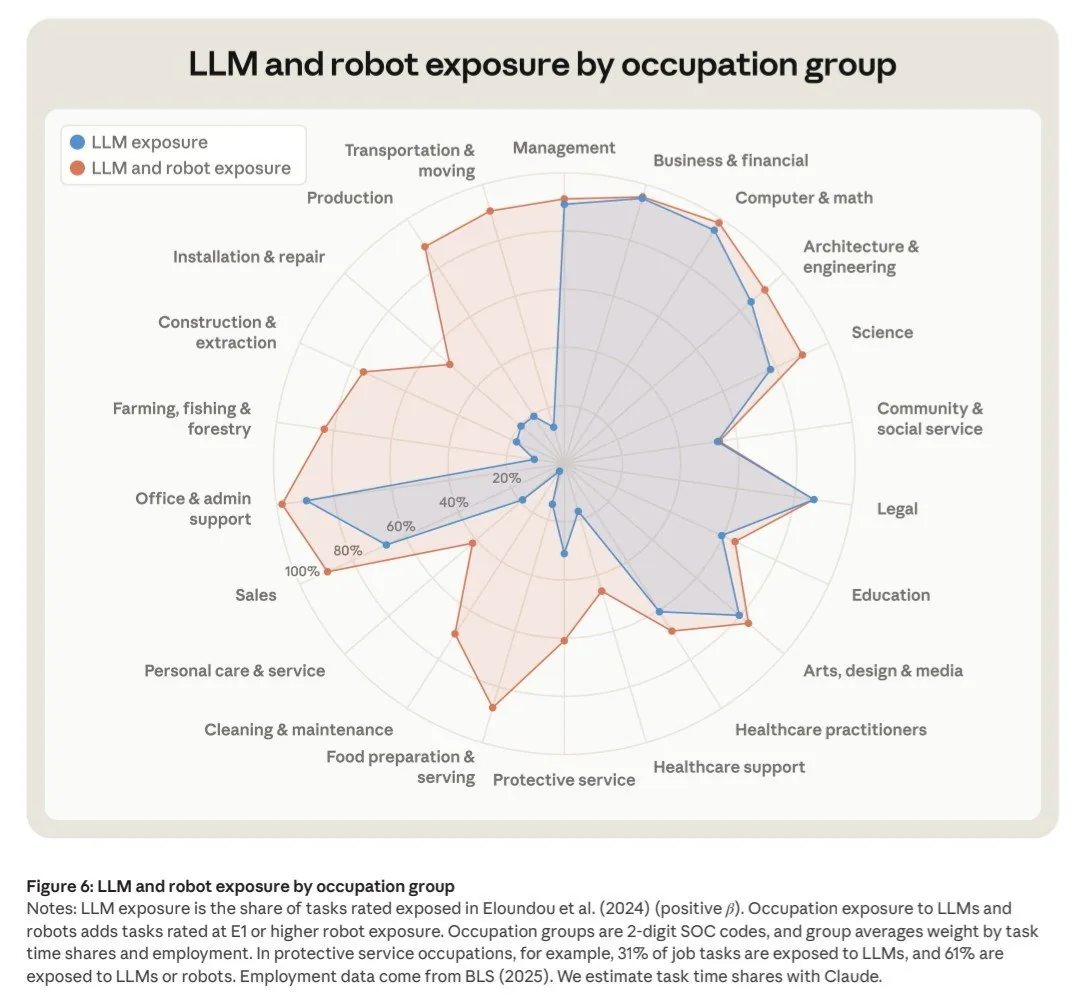
At the end of last year and into this one I was showing a chart in those workshops. Anthropic's radar of where AI capability sits across occupations, next to my own exposure dashboard. The radar has big blue lobes over office and admin, legal, computing and finance, and almost nothing over transport, construction, installation, farming or cleaning. My dashboard said the same thing in bars: clerical work 82 out of 100, trades and construction 28, personal services 22. The tradies looked at that slide and relaxed. I didn't let them. The chart was honest, but it measured a brain in a box, and I told them the safety they were reading off it was a mirage. Robotics is the next step, it's already here, and most people haven't noticed yet. I've been saying that for years. What's arriving now isn't news. It's confirmation.
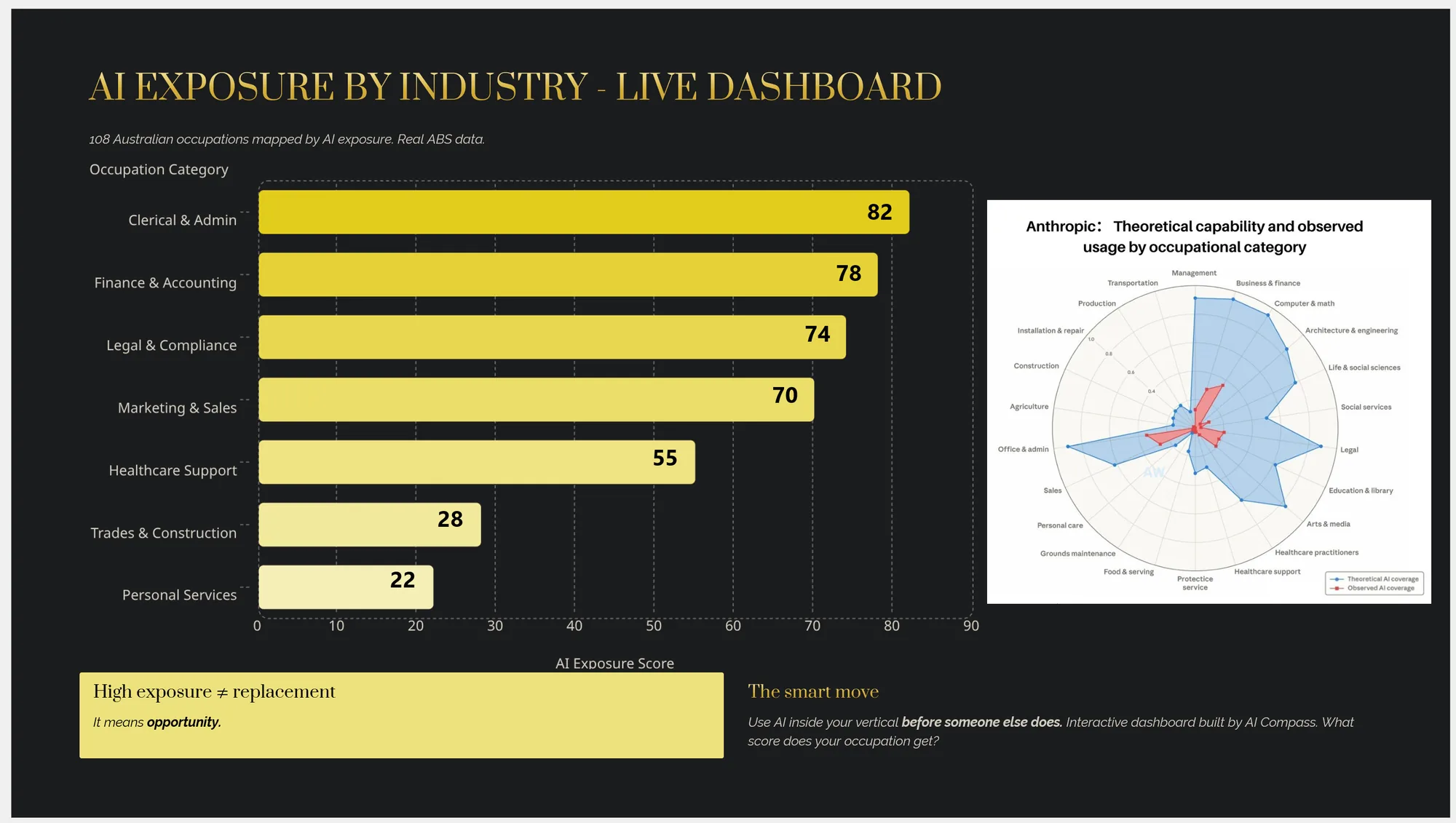
On 30 September Anthropic published the same radar with the gaps filled in. Blue is work exposed to language models. Orange is work exposed to language models or robots. Roughly half of all work is exposed to language models alone. Add robots and it's 81 per cent. Transport and moving goes from under 15 per cent to about 90. Office and admin support goes to nearly 100. Protective services from 31 to 61. Every lobe that was missing in March is now drawn in orange.
Anthropic also wrote the sentence the sceptics will quote all year: robots are cost-competitive for 0.3 per cent of work today. Hold both numbers. 81 and 0.3. The distance between them is this entire issue.
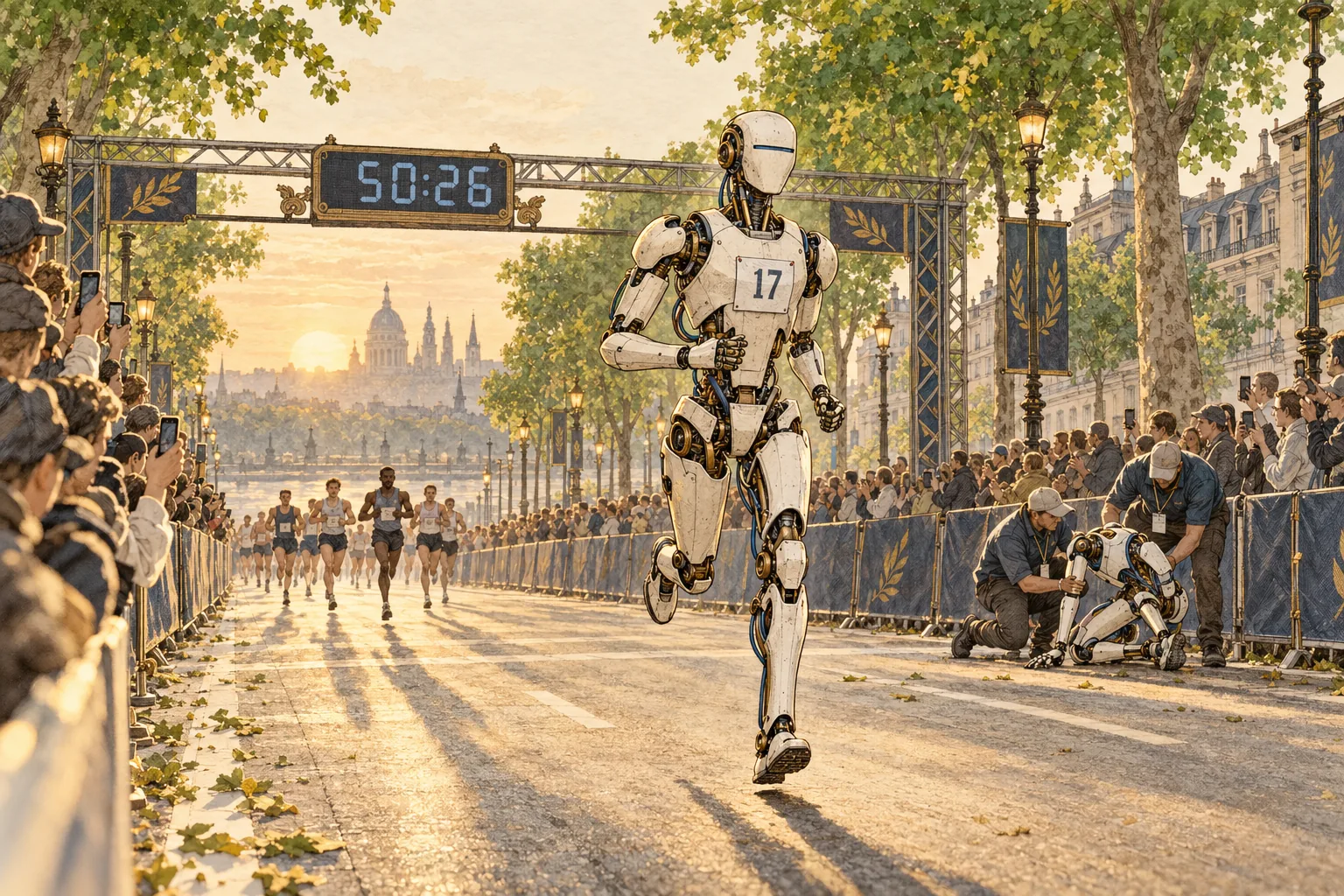
And in case the chart feels abstract: on 19 April a humanoid robot ran a half-marathon through Beijing in 50 minutes and 26 seconds, faster than any human being has ever run the distance. Twelve months earlier, at the same race, the winner took two hours and forty minutes and most of the field fell over.
This issue puts all of that in front of you. Not to scare you. To fix a measurement problem, and then to say who the next three years belong to, because it isn't the robots.
Seventy years each way
In Back to the Future Part III, Doc Brown gets thrown seventy years backward from 1955 and lands in 1885. Horses, a telegraph, kerosene. Not a slightly earlier suburb. A different civilisation.
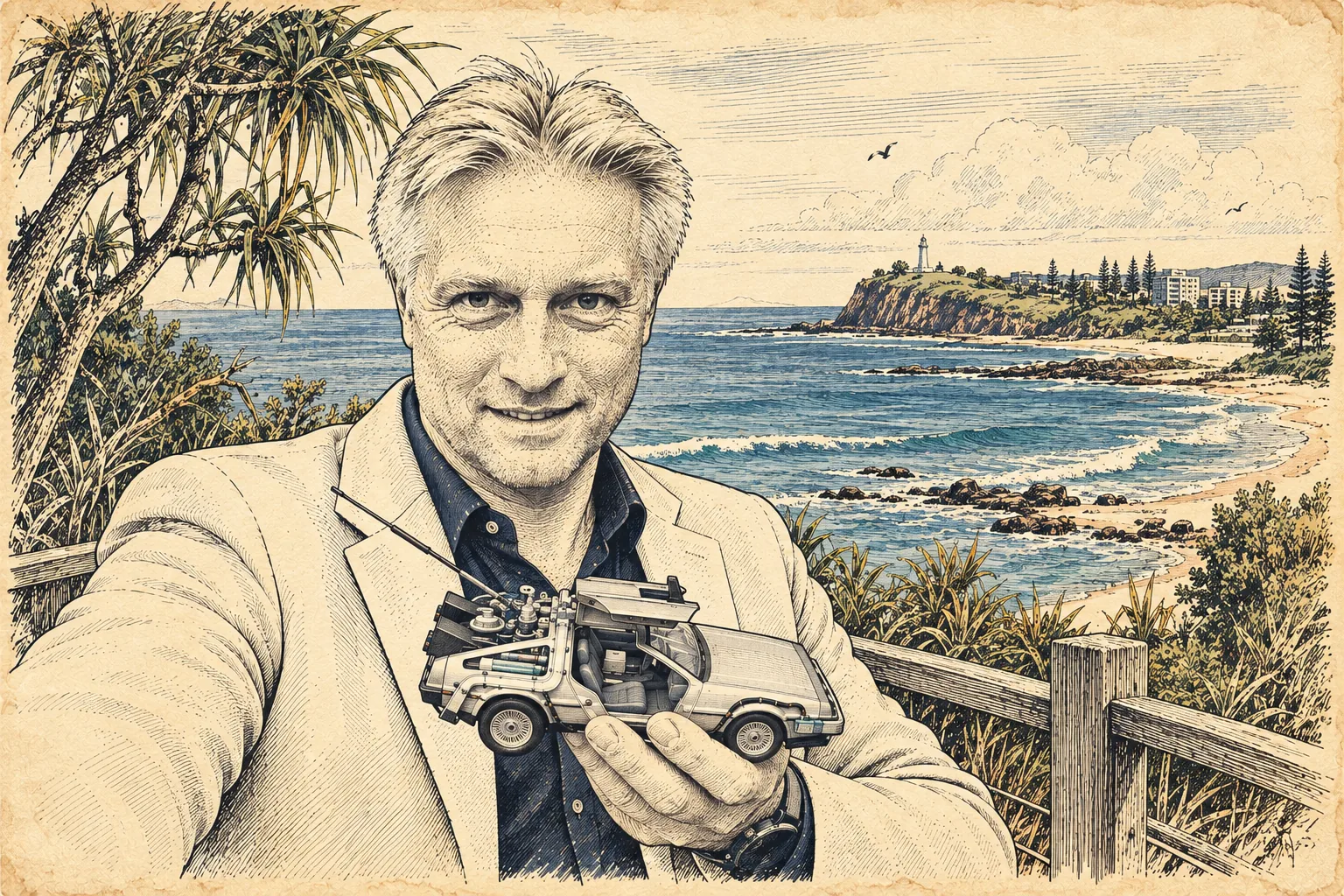
Now run the same seventy years forward from 1955. You land in 2025, and one more year brings you to now. Not a polite upgrade of mid-century life, but a world where software that improves itself with data is being loaded into machines that walk, and where those machines are being built on production lines that are themselves mostly automated. Equal calendars. Unequal change.
That asymmetry is the whole argument. Calendar time is linear. Capability isn't. For most of history you could live an entire life and watch tools change only at the edges. The twentieth century broke that, and the thing that broke it wasn't more inventions. It was feedback loops closing. Software that learns from data. Hardware you can simulate before you build it. Capital that funds five generations of the same platform. Factories that learn from every unit shipped. Once those loops close, progress stops being a queue of lonely breakthroughs and becomes a compounding system. Tools improving the tools.
Last August I told a Polish Australian Chamber fireside chat that we were already on the hyperbola and that exponential growth is hard to grasp. A few people chuckled when I mentioned cold fusion. That's the part I've been failing to explain since. So this time I'm not going to explain it. I'm going to show you a chart I've now published three times.
The curve moved. Then it ran out of curve.
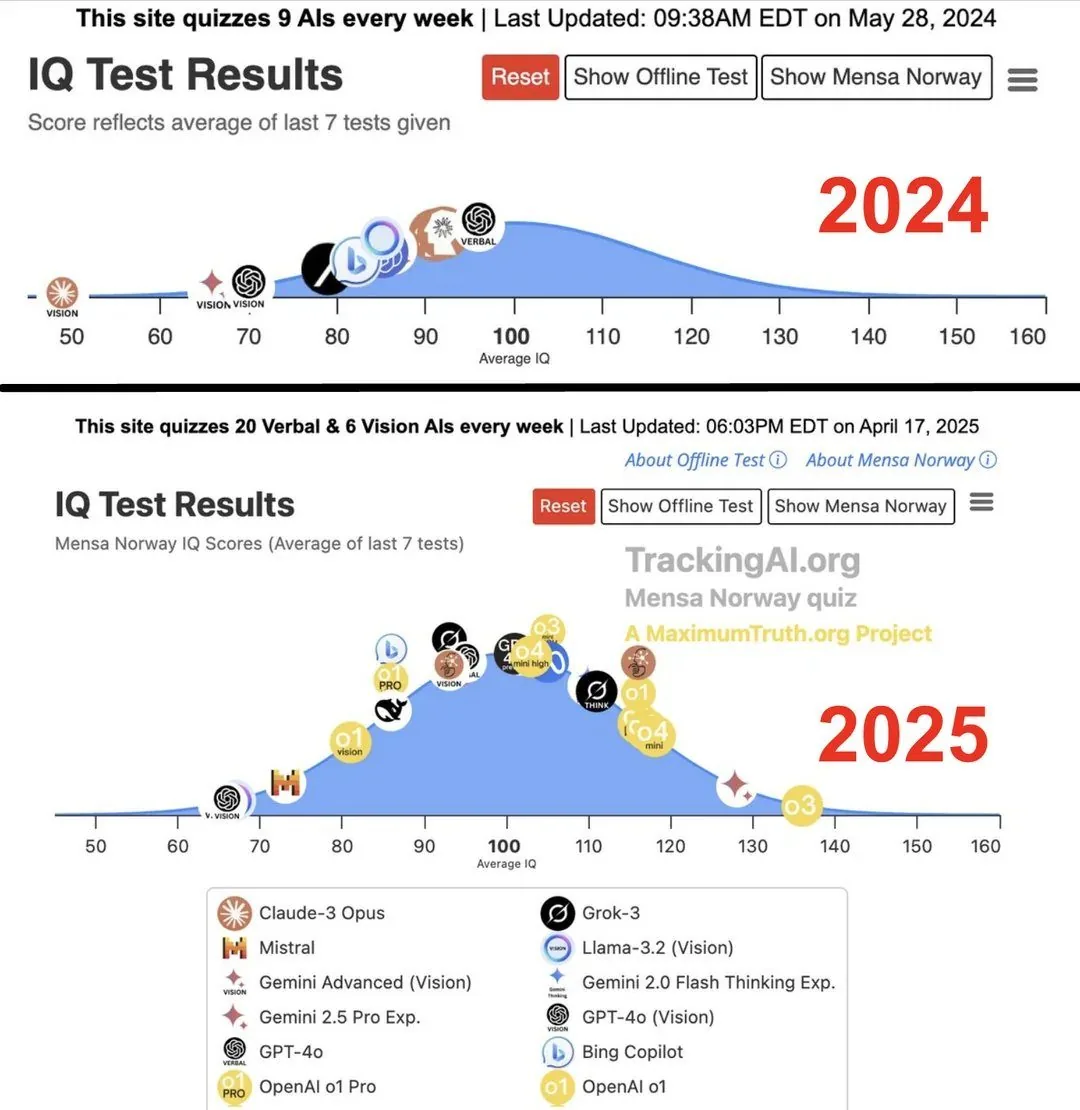
TrackingAI.org has been putting frontier models through the Mensa Norway IQ test every week since 2024. Same test, same scale, humans average 100. In May 2024 the models sat between 50 and 100. Below average, most of them. By April 2025, OpenAI's o3 had reached about 135.
I first ran this chart last November, in the Black Friday issue, when the top model scored 144 and I wrote that the slope wasn't linear, wasn't even exponential, it was approaching vertical. I ran it again in June, the week Washington export-controlled Claude Fable 5, a model sitting in the gifted range on a test built for humans, pulled from every non-American on the planet with one letter. Not a thing. A capability.
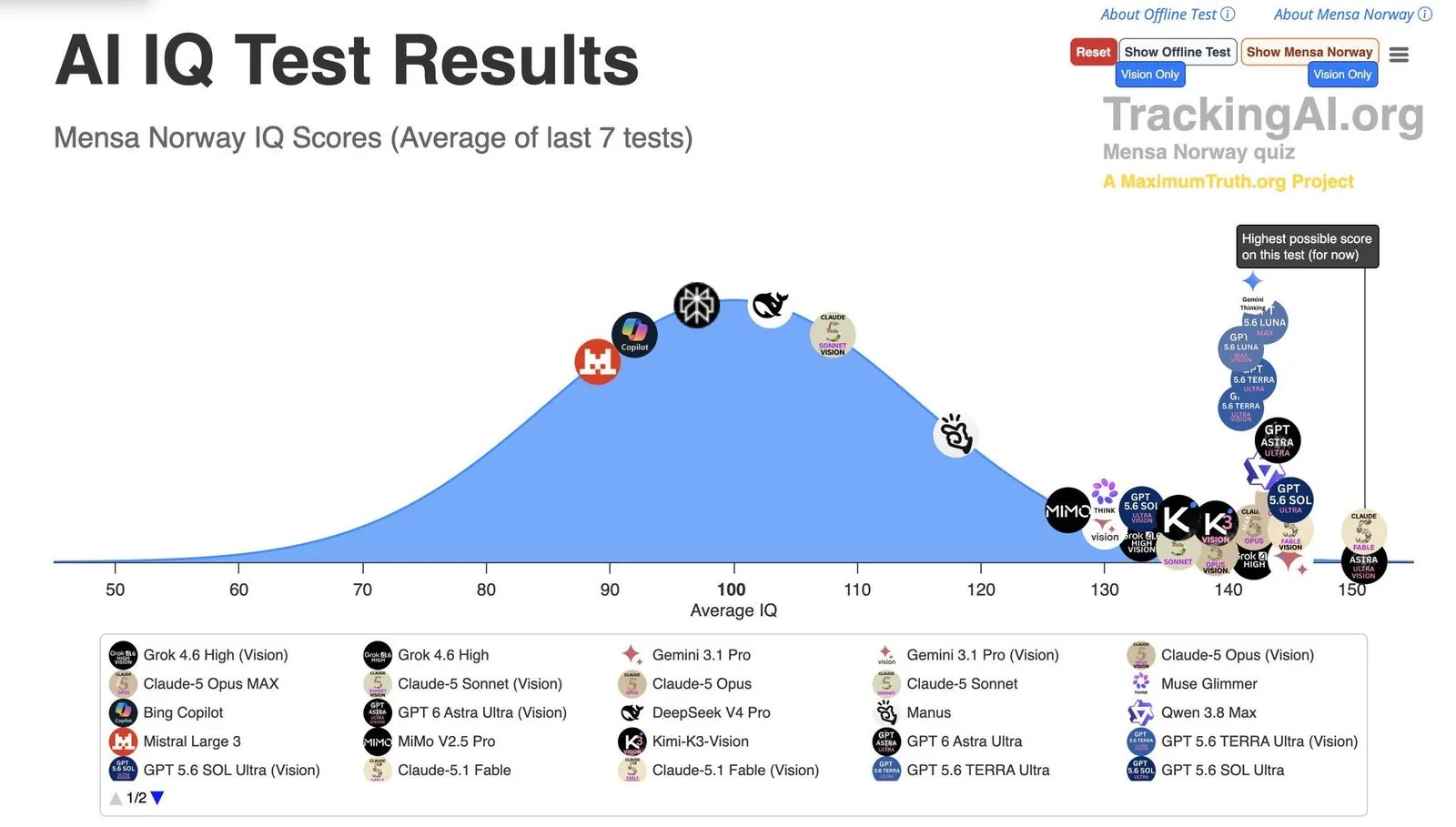
This is the same chart in September. Nearly every frontier model sits between 130 and 150, and a cluster is pinned against a line the site labels "highest possible score on this test (for now)". The test has a ceiling. The models are on it. Twenty-eight months from below average to the top of the ruler. In April I wrote that we weren't at the top of the curve, we were on the knee of it. This is what the knee looks like from above.
aiiq.org breaks it down per model. Claude Opus 5.5, released on 22 September, estimated at 141. GPT-6 Astra at 151 on mathematical reasoning and 155 on programmatic reasoning. Those screenshots were taken on 25 September, three days after Opus 5.5 came out. They aren't mine, I found them online, so check the current numbers at aiiq.org yourself.
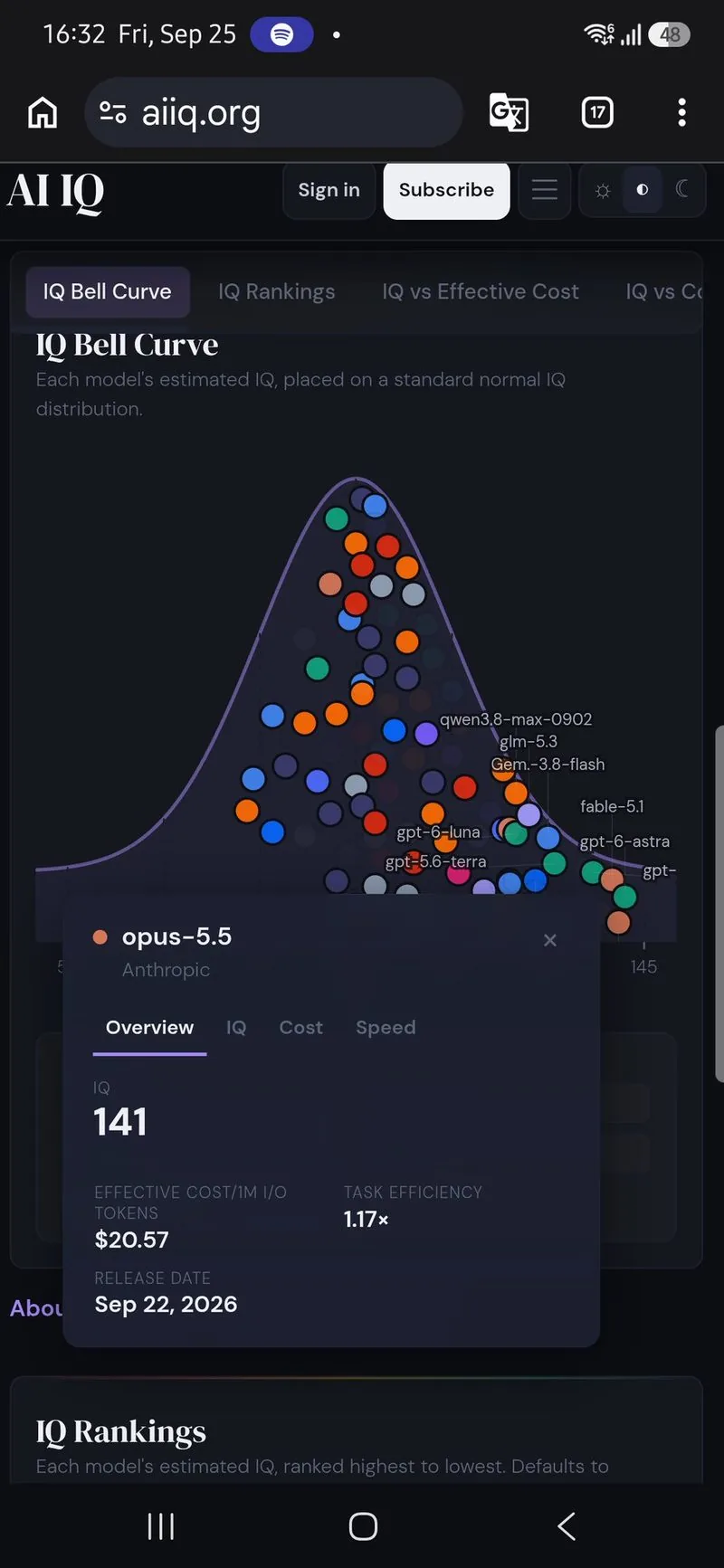
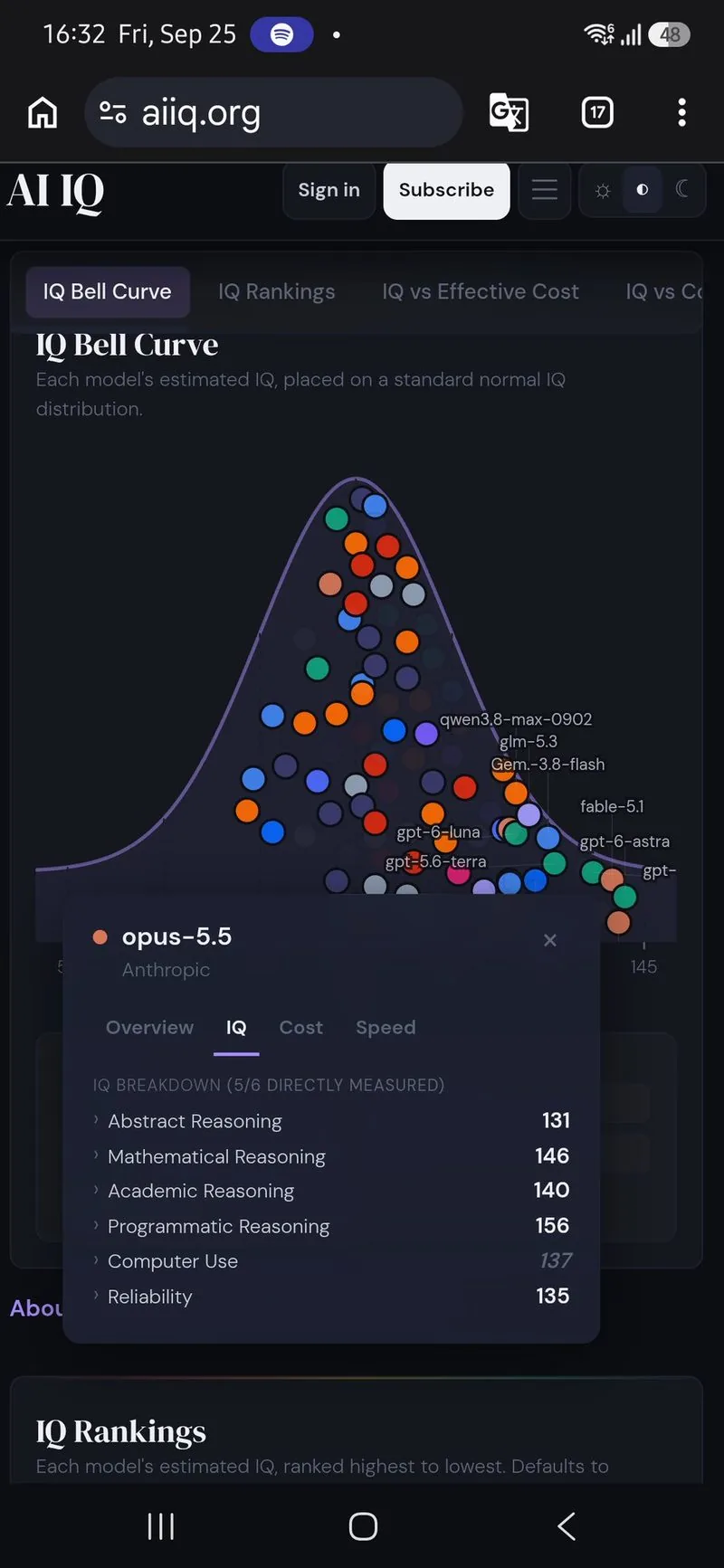
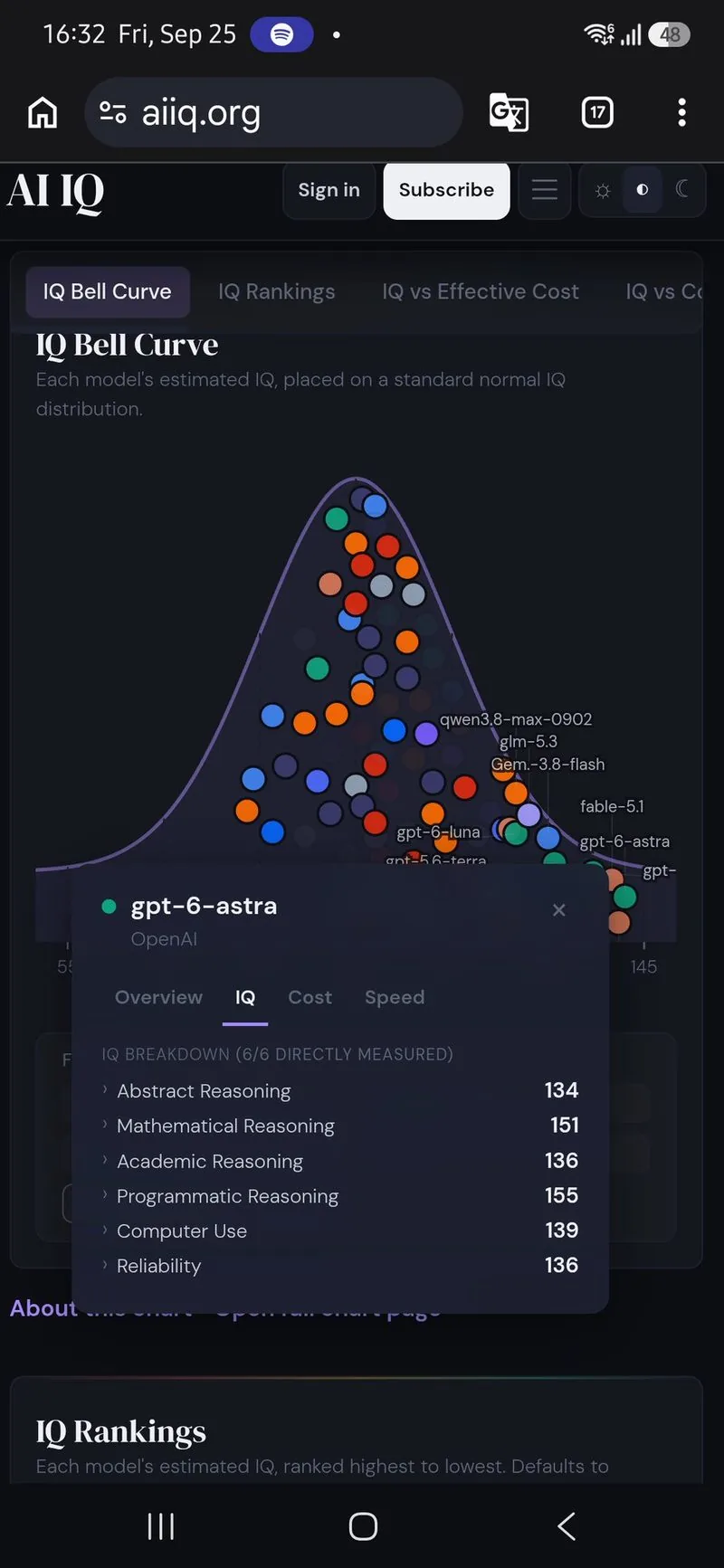
Take the number with the right amount of salt. IQ tests were built for humans, and a model that scores 150 on a pattern quiz still can't run my business. Treat the score as a direction, not a diagnosis. The direction is the point. This is what exponential looks like when someone draws it for you: not a steeper line, a line that leaves the page.
Now here's the bit that matters for the tradie joke. That brain is not staying in the chat window.
The map I built in March
My own map gave the joke its best evidence, and I want to own that before I argue with it.
In March I published a dashboard scoring 108 Australian occupations for AI exposure, built on ABS and Jobs and Skills Australia data. Bookkeepers scored nine out of ten. Electricians scored two. Trades, construction and emergency services sat at the bottom, about 700,000 jobs, and another 3.2 million in healthcare, childcare, cleaning and hospitality sat one band above them. My words at the time: the work is physical, unpredictable, and happens in environments robots can't navigate. If your output is a file, I said, your job is being repriced right now.
If your output is a file, it's being repriced. If your output is a pallet on a truck, the repricing now has a start date.
The map was right about the brain in a box. It was built for a brain in a box. Six months later the box is gone, and 3.9 million green and yellow tiles need a second look. Not because the plumber gets replaced by Christmas. Because the reason I gave for the plumber's safety was a statement about robots, and the robots changed. Anthropic's new chart is my March map with the colour changed. The orange ring sits exactly over my green tiles.
Here's why the map looked the way it did. There's a forty-year-old observation in robotics called Moravec's paradox. The things that are hard for humans, chess, calculus, tax law, turned out to be easy for computers. The things that are easy for a three-year-old, picking up a cup, walking on gravel, telling a sock from a towel, turned out to be brutally hard. That paradox is the entire foundation of the blue-collar safety story, and of my green tiles. It's a real observation. It just had an expiry date, and the date was the moment the same exponential that produced that IQ chart got pointed at hands.
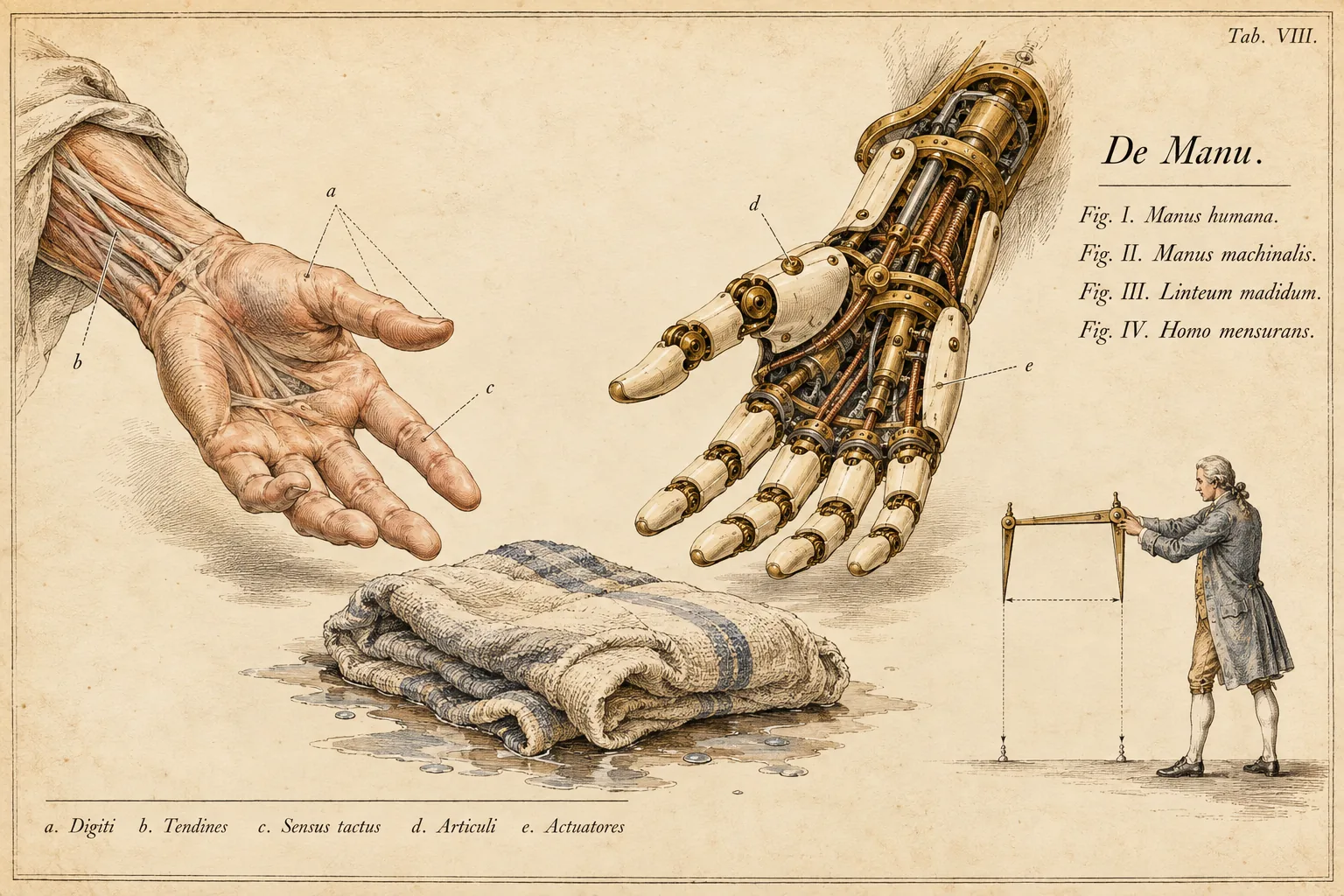
Here's what changed, in plain language. Robots used to be programmed task by task. The frontier ones now run a single neural network that takes in camera pixels and a spoken instruction and outputs motor commands. The industry calls them vision-language-action models. What matters is that they're trained the way language models are trained, on enormous piles of data, and they show the same behaviour language models showed: they start doing things nobody explicitly taught them.
Four releases in five months. Physical Intelligence's π0.7 in April, a model that handles tasks it was never trained on and surprised its own researchers. Google DeepMind's Gemini Robotics 2 in July, one model driving a humanoid from feet to fingertips: walking, crouching, unscrewing a light bulb, tying a bin bag. Figure's Index in August, an app that pays people in 108 countries to film themselves doing chores, sixteen million videos at launch. And on 17 September, Figure's Helix 2.5.
Figure rented thirty houses around the Bay Area. The robots had never seen them. No training on the homes, no training on the objects in them. They walked in and tidied, folded towels, made beds, and completed 56 per cent of the tasks. The same system without the human-video pretraining managed 9 per cent.
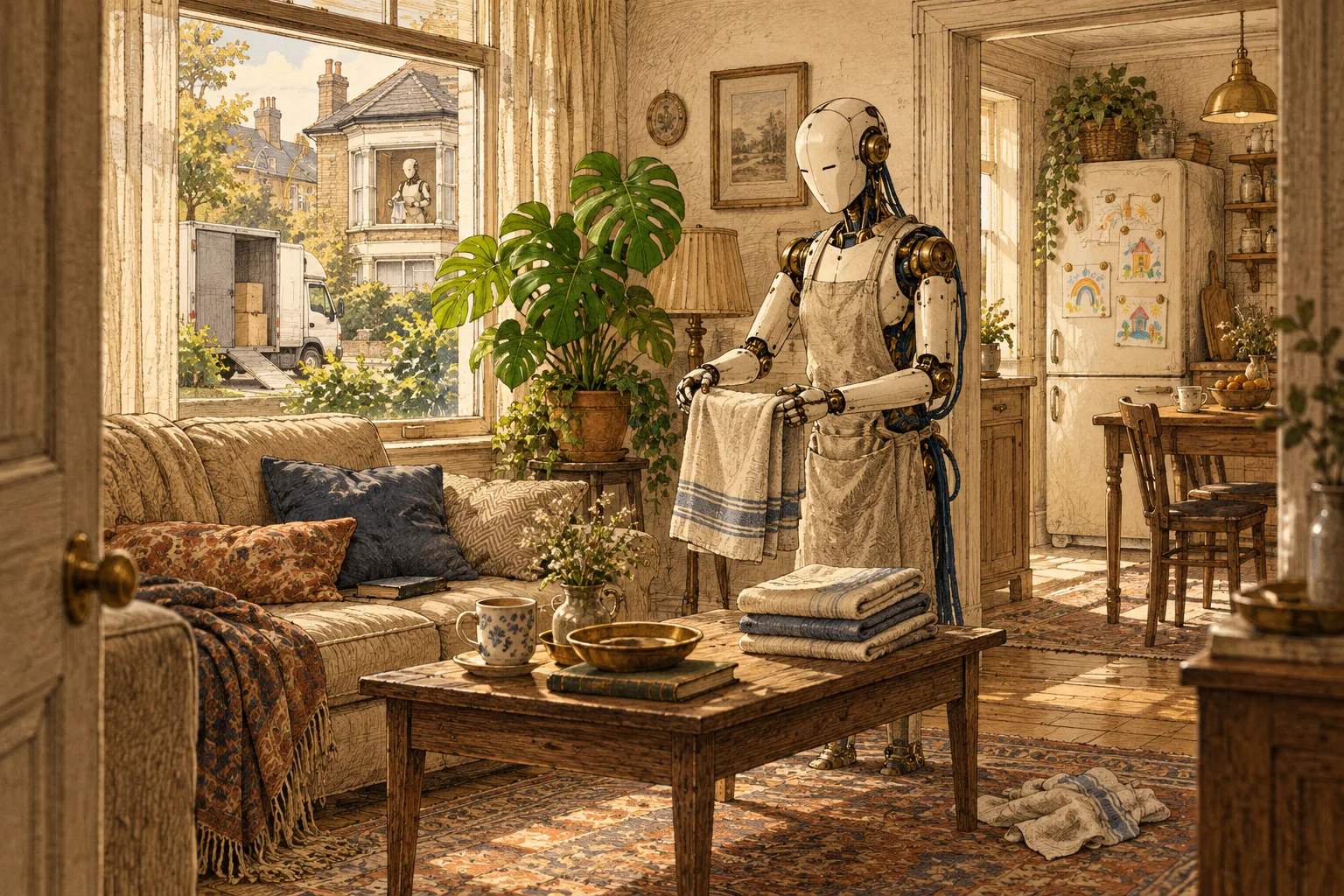
Read that both ways, because both are true. A robot failing 44 per cent of its chores is not a product. And a robot that walks into a stranger's house and does anything useful at all is something that did not exist twelve months ago at any price. Figure posted nearly four hours of uncut footage. Watch ten minutes of it. It's boring. That's the point. Boring is what work looks like.
The numbers behind the demos
Demos are cheap. Shipments aren't.
In the first half of 2026 somewhere between 19,000 and 22,000 humanoid robots shipped worldwide, depending on which tracker you trust. Roughly triple the year before. Chinese makers shipped 86 to 97 per cent of them. China's industry ministry expects the country to build more than 100,000 this year, five times 2025.
Unitree, the Hangzhou company behind the robots you've seen doing kung fu on your feed, shipped more than 5,500 humanoids last year, grew revenue 335 per cent, and listed in Shanghai in August at about US$9 billion. Its entry-level R1 sells from US$4,900. That's less than a second-hand ute. It's a toy, not a worker, and I'll come back to that. But it's a walking, talking, cartwheeling toy at ute money, and the price of the toy is how you read the cost curve of the worker.
On 8 September XPeng, the Chinese EV maker, commissioned what it calls the world's first automated production line for humanoid robots, more than 80 per cent of core processes automated, and its IRON robot walked off the end of it on its own. Robots assembling robots. That's the recursion from the ruler diagram, made of metal.
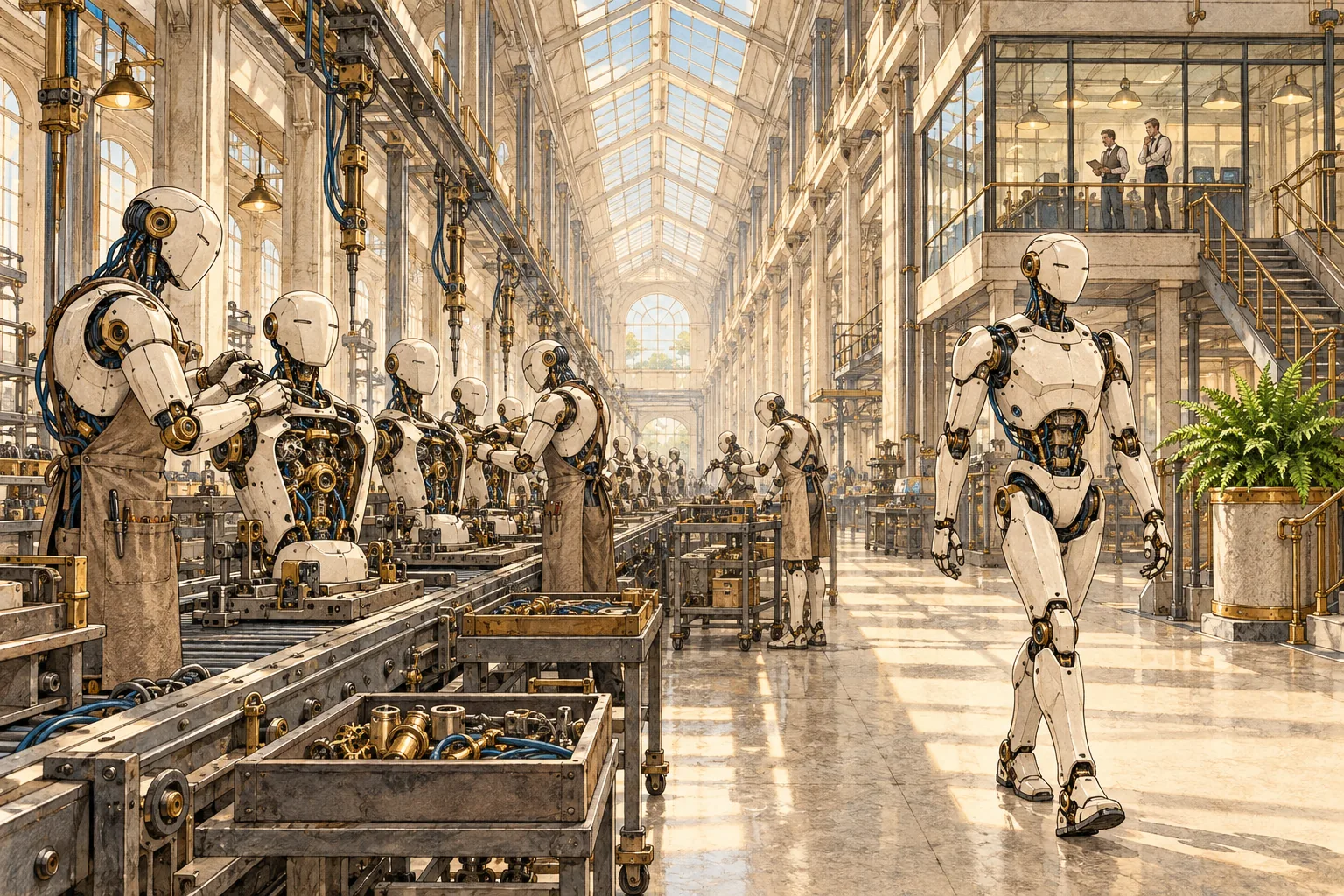
In the West the story is fewer units and more paid work. Figure's earlier robot ran ten-hour shifts at BMW's Spartanburg plant for eleven months and loaded more than 90,000 parts. Agility's Digit has logged more than 65,000 hours at nine customer sites and holds over US$300 million of contracted orders. On 21 September Boston Dynamics opened a training centre inside Hyundai's Georgia plant; Hyundai plans 25,000 Atlas robots across its factories and a plant that builds 30,000 a year by 2028. Tesla has torn out the Model S and X line at Fremont to build Optimus, says production is "anticipated later this year", and Musk says the robot will eventually be 80 per cent of the company's value. Tesla has also moved its own Optimus dates more than once. As of late September the third-generation robot still hadn't been unveiled, and the best look anyone had came from 3D models found inside Tesla's own phone app. Believe the direction, discount the date.
And the analysts, who are paid to be late rather than wrong, keep revising in one direction. Morgan Stanley raised its 2026 China shipment forecast twice in six months, from 14,000 to 28,000 to 50,000. In September Goldman Sachs lifted its 2035 forecast from 1.4 million humanoids to 6.5 million, and its 2030 number from 256,000 to 890,000. Every major revision this year went up. That pattern, not any single number, is the tell.
The second loop
In July I drew a loop. Trust earns attention, attention pulls in intelligence, intelligence burns tokens, and whatever you ship either tops the trust up or drains it. Machines own the middle of that loop. Humans own the two ends.
This is the second loop, and it lives entirely in the machine middle.
Language models had a ready-made library to learn from: the internet, a few centuries of humans writing everything down. Robots have no equivalent. There is no internet of what it feels like to pick up a wet towel. So every humanoid on a factory floor is also a sensor for the next model. Musk said it out loud in January: the Optimus units inside Tesla are "primarily for learning and data collection rather than performing productive tasks". Figure is paying the public for chore videos. China is building state-backed training grounds where robots exist to generate data.
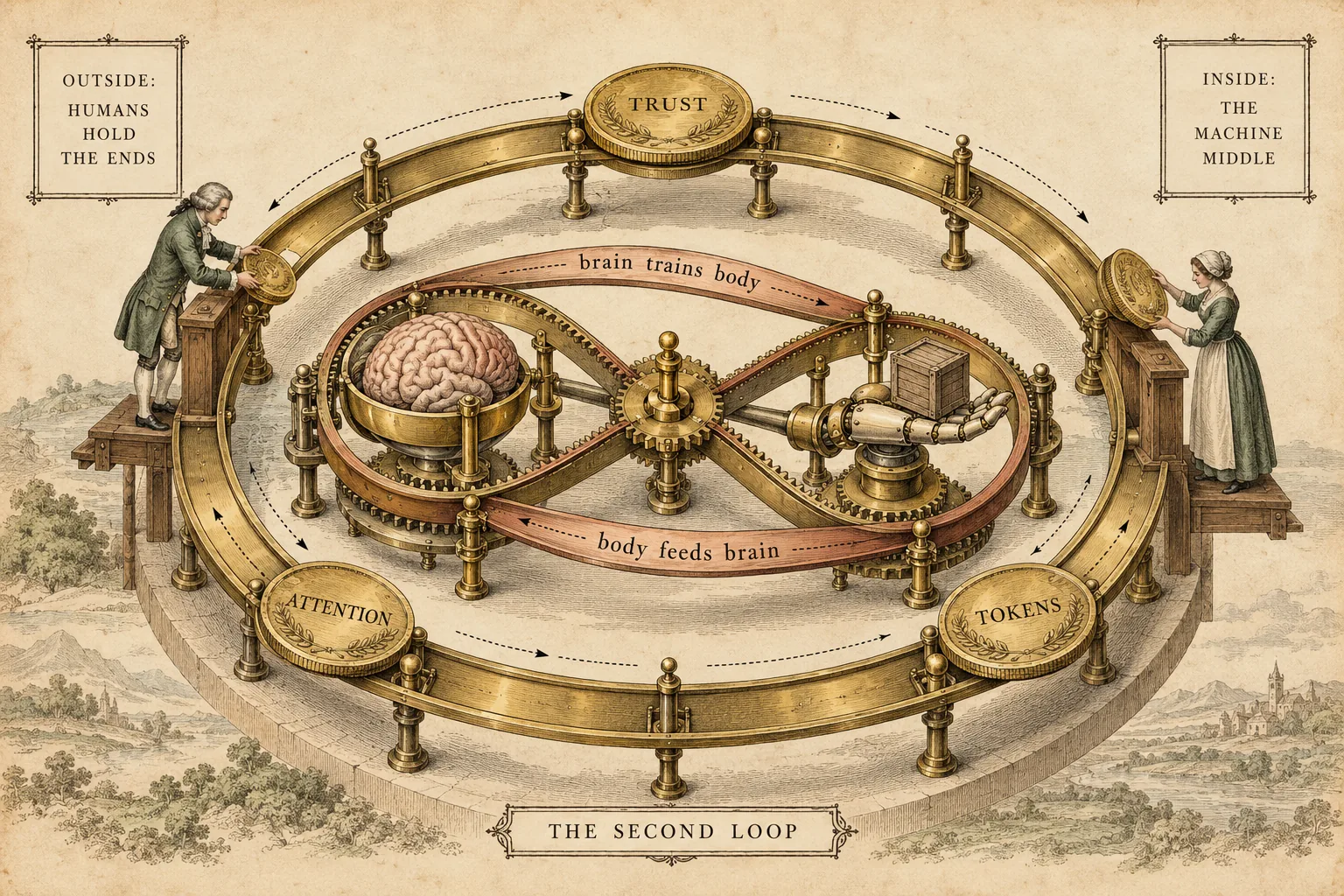
Brain trains body. Body feeds brain. Every deployment makes the next model better, which makes the robot useful in more places, which produces more data. That isn't a supply chain. It's a flywheel, and it's the same flywheel that took the IQ chart from 80 to 150. A token used to be a slice of thought. Now it's also a slice of a shift.
In Issue #1 I argued that every previous information technology was a channel between humans, and that AI is the first one that participates. This is what participation looks like once it has hands.
The sceptics are holding a ruler
I've built enough AI systems to know the demo is never the deployment. The sceptics know it too, and most of their facts are right. Where they go wrong is the arithmetic. Every serious case against this issue takes today's pace and lays it along a ruler.
Rodney Brooks founded iRobot and Rethink Robotics. He has shipped more real robots than most of the people on my feed combined. His January scorecard says deployable dexterity will stay "pathetic compared to human hands beyond 2036", and that without new mechanical designs, walking humanoids are too unsafe to work next to people. He suggests standing at least three metres from a full-size one, because sixty kilos of falling metal is sixty kilos of falling metal. On safety he's right, and I'd keep the three metres. On 2036 he's drawing the next ten years of hands with the last forty years of hands, and for most of those forty years engineers programmed every grip by hand. The next ten are being trained, the same way the brain was. Look at what landed while I was finishing this issue. On 1 October Boston Dynamics gave the production Atlas new hands: four fingers, 13 joints, pressure sensors across the fingertips and palm, built for mass manufacturing, and designed in high-fidelity simulation so they can be trained there before they touch a real tool. The company lists drills, torque drivers, grinders, nail guns and welding torches among the tools they're built for. Alberto Rodriguez, who leads robot behaviour on Atlas, put it in one line: "If you give dexterous hands to a robot, make them do dexterous things." And hands aren't the first job anyway. Totes and pallets are.
Ken Goldberg at Berkeley calls it the 100,000-year data gap. Reading the text that trained today's language models would take a human about that long, and the equivalent data for the physical world doesn't exist on the internet. True. But nobody is collecting it at human reading speed. Figure's Index app launched with sixteen million chore videos from 108 countries. And robots learn in a way no human apprentice can.
When a tradie drops a load off a pallet, the lesson stays with that tradie. Maybe it becomes a story at smoko and an apprentice remembers it. When a robot drops the same load, the failure is logged, the shared model is retrained on it, and every robot running that model gets the lesson in its next update. The experience of one becomes the experience of the whole fleet. Geoffrey Hinton, who shared the 2024 Nobel Prize in Physics for the work behind neural networks, put it plainly in 2023: when one copy of a digital model learns something, "all the others know it", so ten thousand copies "can see 10,000 times as much data as one agent could". Goldberg's own answer to his own gap is that flywheel. A gap measured in human years closes in fleet years, and fleets compound.
We pass experience on by talking. Machines pass it on by copying.
Then Anthropic. The same report that drew the orange ring says robots can technically do about three quarters of physical tasks, 34 per cent of all work time, but are cost-competitive for 0.3 per cent of it today. At the historical pace of robot price declines, it takes about forty years for robots to undercut people on even 10 per cent of US work. Yahoo Finance ran it under the headline that blue-collar workers have decades. It's the best-sourced version of the tradie joke ever written, from the company whose model I use every day, and the condition is printed right there: at the historical pace. Hold on to that condition. It's the whole argument, and I'll come back to it.
The demo problem is real too. Tesla's 2024 Optimus bartenders were widely reported to be remote-controlled. Roughly 60 per cent of the robots in that Beijing half-marathon were remote-controlled. 1X, the company taking US$20,000 pre-orders for a home robot, says openly that it learns chores partly with a human operator driving it remotely, and as of July nobody had verified a single customer delivery. Morgan Stanley's advice to its own clients: if a humanoid demo doesn't say autonomous, assume it isn't. Good advice. Now look at what the remote operator is doing. Every hour a human drives a robot is an hour of training data for the version that won't need one. Teleoperation is how autonomy gets made. And the robot that won in Beijing wasn't remote-controlled.
So here's the pattern. Every number in the sceptics' case is a measurement of today, extended in a straight line. That's exactly how you'd have read the IQ chart in May 2024, with the models sitting below average. Nobody drawing a straight line from there put them on the ceiling of the test inside three years. It took twenty-eight months. The sceptics aren't wrong about where the robots are. They're wrong about how fast that changes, because they're standing on the steep part of a hyperbola and measuring it with a ruler.
Why 2027 to 2030
I've been telling anyone who'd listen for the last few years that 2027 to 2030 is when this stops being a demo category. I'll say what I mean by that, because "revolution" is a lazy word and I've used it myself.
I don't mean a robot in every home by 2030. I mean three curves crossing in the same window. Models that generalise, which is this year's story. Chinese unit costs that keep falling, with a capable biped now starting under US$5,000. And factory contracts that are signed rather than announced: Hyundai's 25,000, Agility's US$300 million, BMW, Foxconn and BYD buying from UBTech. The banks' base cases now have shipments rising roughly tenfold between 2026 and 2030, almost all of it in factories, warehouses and logistics.
Which brings me back to Anthropic's 0.3 per cent. Read the condition attached to the forty years: if the pace of robot cost declines holds. That is the ruler. Every number in the shipments section is an argument that the pace is not holding. Volume tripled in a year. A biped went from six figures to under US$5,000. Forecasters revised five times upward. Anthropic measured the gap between 81 and 0.3 against today's robot prices, and it did the measuring honestly. My claim is about the prices after 2027. In March Musk said Optimus 3 production starts slowly this year and reaches high volume around the middle of next, off a Fremont line built for a million robots a year, with a Texas line planned for ten million. Then the line that matters more than any date: "We'll try to release a new robot design every year." In July he told investors the early ramp will be long and flat, because almost none of Optimus's parts have a mature supply chain yet. Discount the dates. Keep the multiplication: a new generation every year, each one trained on everything the last one did, coming off lines sized in millions. Hyundai's plant is planned at 30,000 a year by 2028.
And that only counts the companies already in the race. When ChatGPT launched in November 2022, the frontier was a handful of labs. Within a year Mistral, xAI and DeepSeek had been founded, and China alone had at least 130 large language models. The Chinese press called it the war of a hundred models. Humanoids are at that point now. Last November China's state planner counted more than 150 humanoid makers, more than half of them startups or newcomers, and warned of a bubble. Plenty of them won't survive. Plenty of AI labs didn't either, and the price of intelligence still fell every year.
Every forecast in this issue scales the companies that already exist. None of them counts the ones that haven't been founded yet.
This time the pattern runs on steroids, because the tool is improving the toolmakers. AI already lays out the chips it runs on, and Google's AlphaChip has designed layouts for its TPUs. DeepMind's GNoME found 2.2 million new crystal structures in 2023, materials nobody had catalogued. The next robot body won't have to be built from today's parts. ETH Zurich has a robotic leg that walks and jumps on electrohydraulic artificial muscles instead of electric motors. Clone Robotics, which works out of Warsaw and Mountain View, is building a full android around water-powered synthetic muscle fibres. Both are early, and electric motors still drive the humanoids working in factories today. But each step feeds the others: the models find the materials, the materials make the muscles, and the robots built with them collect the data that trains the next models. Everything compounds against everything else. That's takeoff, and no ruler can hold it. If the pace holds, I'm wrong about the window. If the curve is doing what the IQ chart did, the window is 2027 to 2030. That is the bet, and it's a bet on a slope, not a demo.
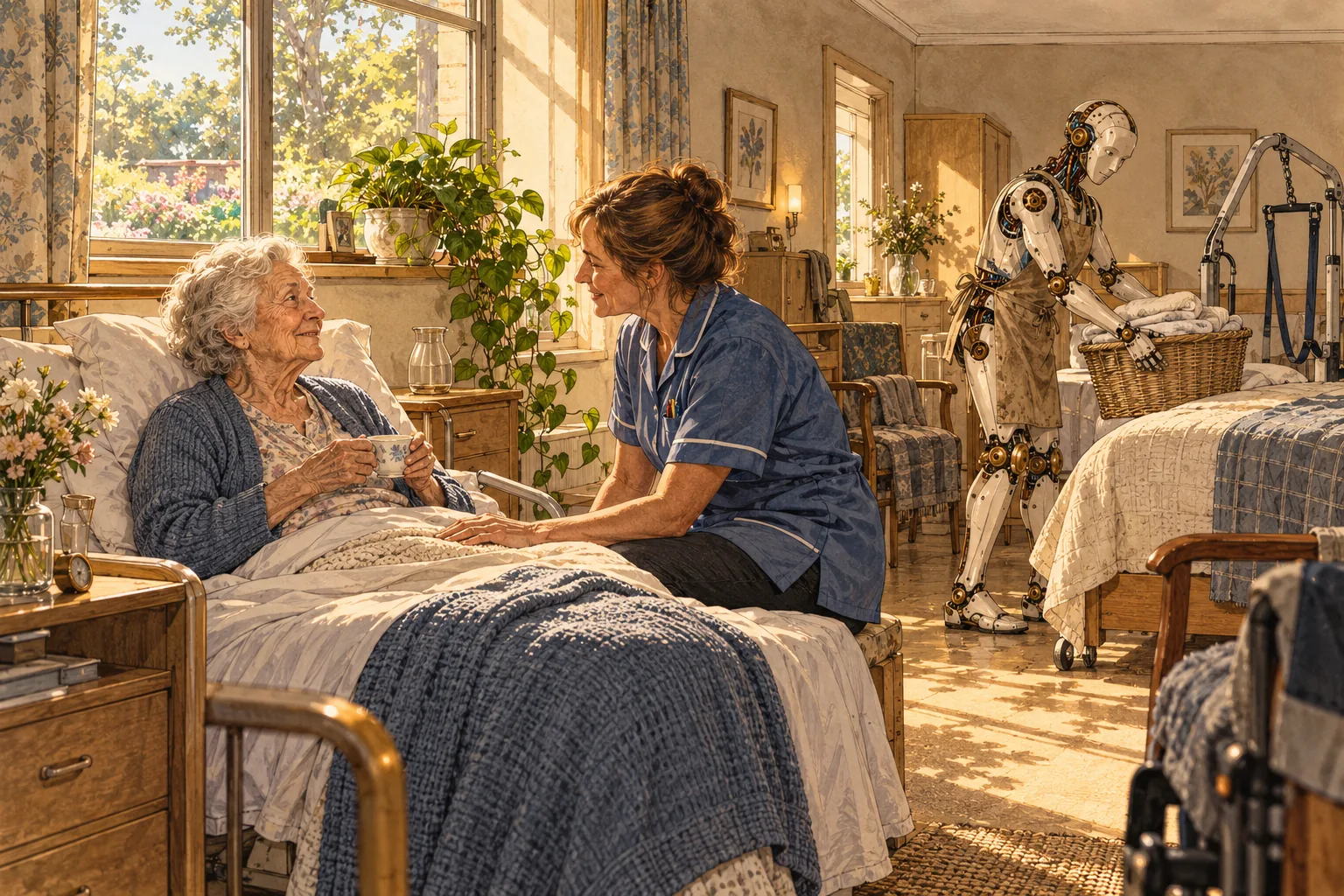
So the sequence isn't "the robot takes your job". It's "the robot takes the shift nobody wants to work". Night-shift parts sequencing. Tote picking. Pallet loading in a forty-degree shed. Then the tasks in aged care that break carers' backs. Then, later than the marketing says and sooner than the sceptics say, homes.
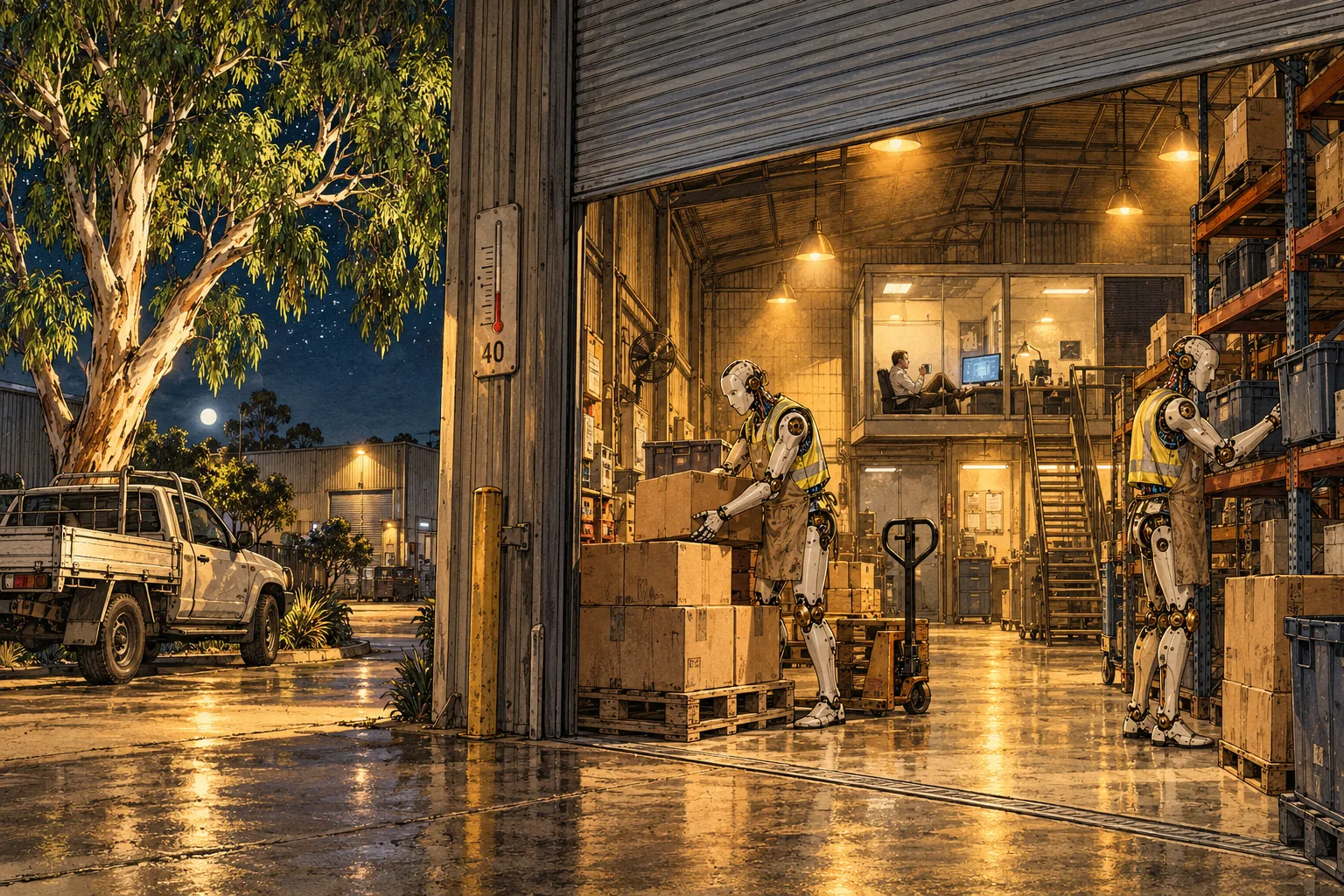
The joke was half right. White collars did go first, in the sense that the IQ chart is a white-collar chart. What the joke got wrong is the assumption underneath it: that the brain would stay in the box. It didn't. It got a body, and the body's price is falling faster than the brain's ever did.
The brain didn't stay in the box. It got a body, and the body's price is falling faster than the brain's ever did.
Brains from one jurisdiction, bodies from another
Australia builds neither the brains nor the bodies. In June I watched Washington switch off the best publicly available brain on the planet for every non-American with one letter. In July the FCC put foreign-made humanoids and quadrupeds on its national-security Covered List, the same list as Huawei network gear. In August the company that shipped more humanoids than anyone in 2025 listed in Shanghai. Read those three months together. The brains come from a jurisdiction that has already switched them off once. The bodies come from a jurisdiction the Americans have just declared a security risk. Australia sits between the two with a chequebook.
AgiBot, the largest humanoid maker on earth by units this year, opened an Australia and New Zealand partner network in Melbourne in July. Unitree ships here through two distributors. Whatever robots end up on Queensland factory floors will be Chinese hardware running American or Chinese models, and the data they generate will train somebody else's next version. Robots are becoming sovereign infrastructure, like chips and energy, and a country that imports them inherits three dependencies at once: updates, supply, and a data flywheel turning for someone else. In July I borrowed Mo Gawdat's line that nations importing intelligence end up in the third world. Here it is with a chassis.
None of this argues against buying them. Construction is 141,000 workers short. Aged care runs 30,000 to 35,000 a year short. Nearly a third of assessed occupations are in national shortage. The labour gap we complain about at every chamber breakfast is exactly the gap the first wave fills. It argues for knowing what you're plugging in, whose model it runs and where its data goes, before the invoice arrives. That's the dependency audit I wrote about in April, the one nobody has done yet. It applies to the thing with arms as much as the thing in the browser. In June I called it architecture over capability. Hold that phrase. It's about to matter more than any benchmark.
The next accelerant
One more curve, then I'll get to the point. Quantum. In June IBM committed more than US$10 billion to a roadmap that has its partners demonstrating quantum advantage this year and a fault-tolerant machine, Starling, in 2029. Quantinuum is already selling error-corrected logical qubits and has filed for a listing. The honest industry consensus for useful fault-tolerant machines is 2028 to 2032. At that fireside chat last year I put a twelve-year clock on the energy problem, with room-temperature quantum reaching commercial viability in years three to five. The mainstream path is running to IBM's calendar rather than mine. It's still running. Nobody knows exactly what that does to model training, simulation and materials science. I'd bet it doesn't slow the curve down. That's Issue #6.
2027 belongs to the Architects
Last December TIME gave Person of the Year to eight people sitting on a steel beam. The Architects of AI, they called them: Huang, Altman, Musk, Zuckerberg, Su, Amodei, Hassabis, Fei-Fei Li, painted onto the 1932 photograph of ironworkers eating lunch above Manhattan. I wrote then that the real question wasn't how much AI had changed. It was how much we had. And that the answers wouldn't come from AI. They'd come from us.
Here's my answer, ten months on. The title moves down the beam.
Put the two halves of this issue together. Intelligence is metered by the sip, and the meter is falling. Labour is about to become a depreciating asset at ute money. When brains and bodies both get cheap, the thing that turns them into anything at all is an idea. Someone still has to decide what gets built, for whom, and why. Someone has to hold the drawing. That was always the scarce input. It has just never been this obviously scarce, because until now the brain and the body were scarce too, and we could hide behind them.
The Architects of 2027 aren't eight billionaires on a beam. They're the people with ideas and imagination, holding the drawings. And they're still human, which means the drawings carry their beliefs, their biases and their agendas.
There's a story I told in the Black Friday issue that I keep coming back to. In 2016 AlphaGo played Move 37, a move three thousand years of masters had agreed was wrong. Researchers later found that professional Go had flatlined for 66 years before that game. After it, human players improved faster than at any point in those seven decades. Not by copying the machine. By unlearning the assumptions the machine exposed. The question I asked then still stands: what is AI doing that we'd never try, and why not?
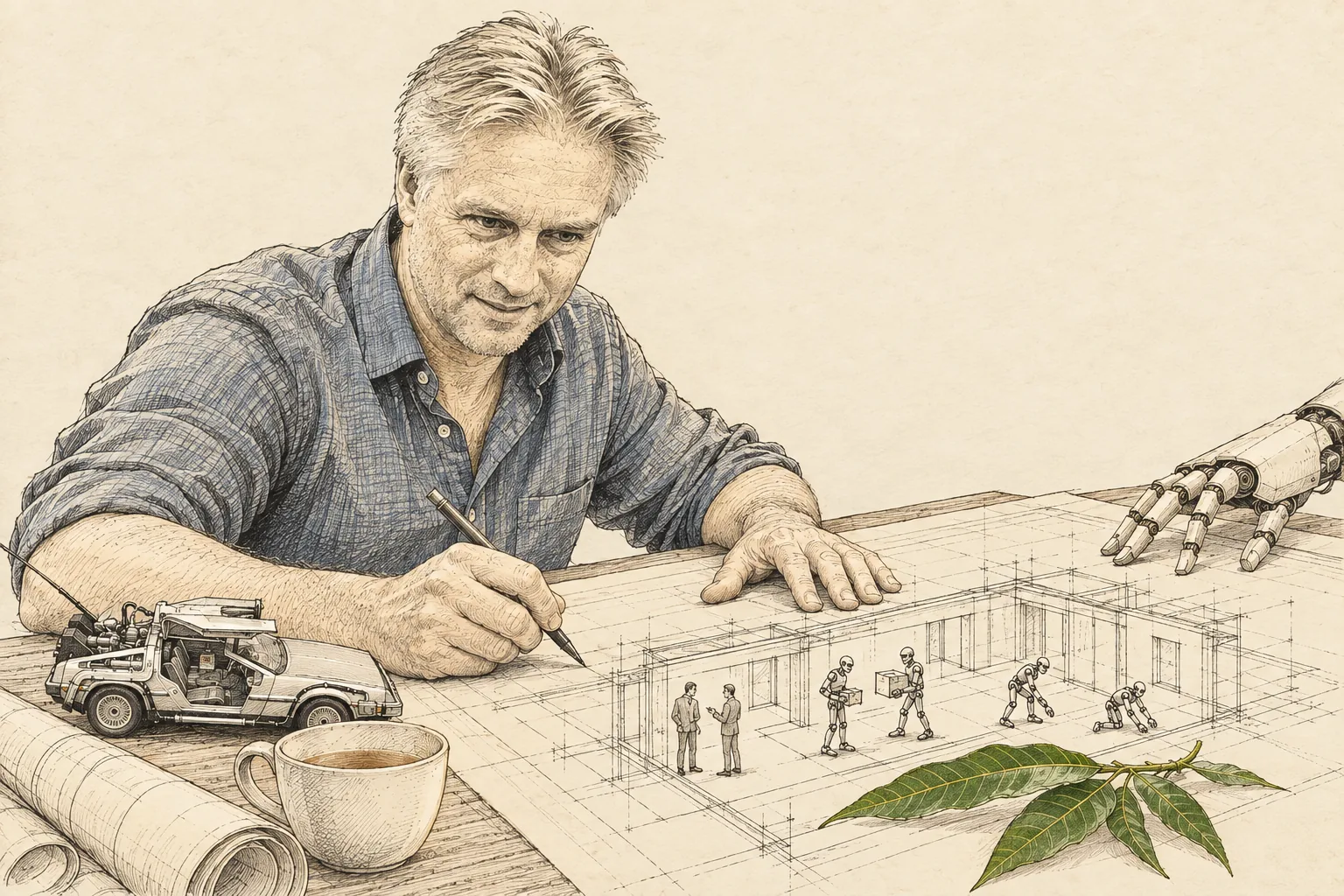
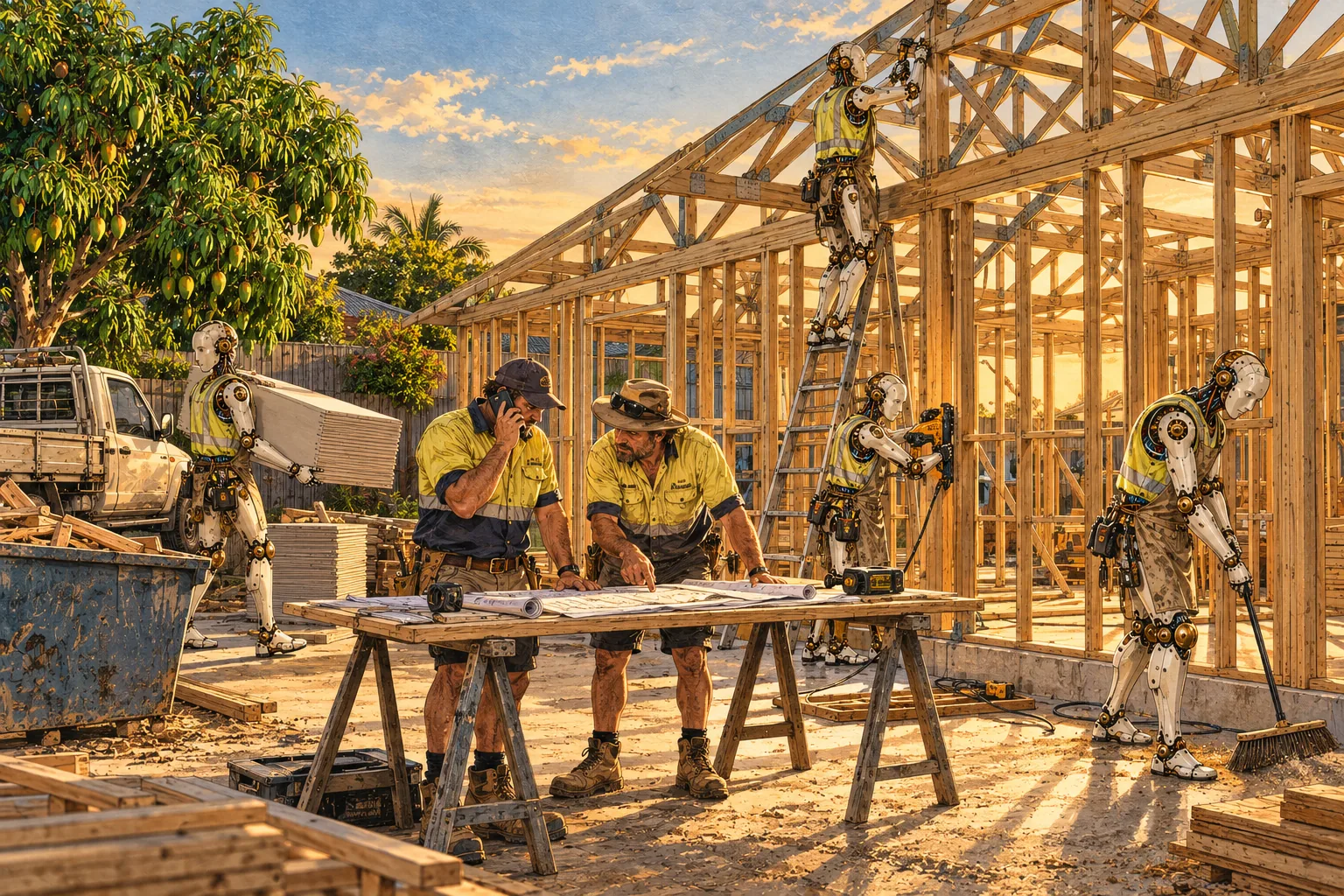
That question now has a job title. The Architects of 2027 aren't eight billionaires on a beam. They're the people with ideas and imagination who can say what to build and why, and who now have a 150-IQ brain by the sip and, soon, a body at ute money to build it with. The tradie who designs a crew of two humans and four machines and wins the contracts the old crew couldn't price. The aged-care operator who works out which tasks a robot should never touch and which one it should take tonight. The manufacturer who redraws the line around the flywheel instead of bolting a robot onto the old one. None of that is a technology skill. It's architecture: knowing what you're plugging in, whose model it runs, where its data goes, and what the humans at the two ends of the loop are for. I said in June that architecture beats capability. In 2027 it's the whole game.
One more thing about the people holding the drawings. They're still human, with their own beliefs, biases and agendas, and a cheap brain and a cheap body don't correct for that. They scale it. That's why the audit matters as much as the ambition.
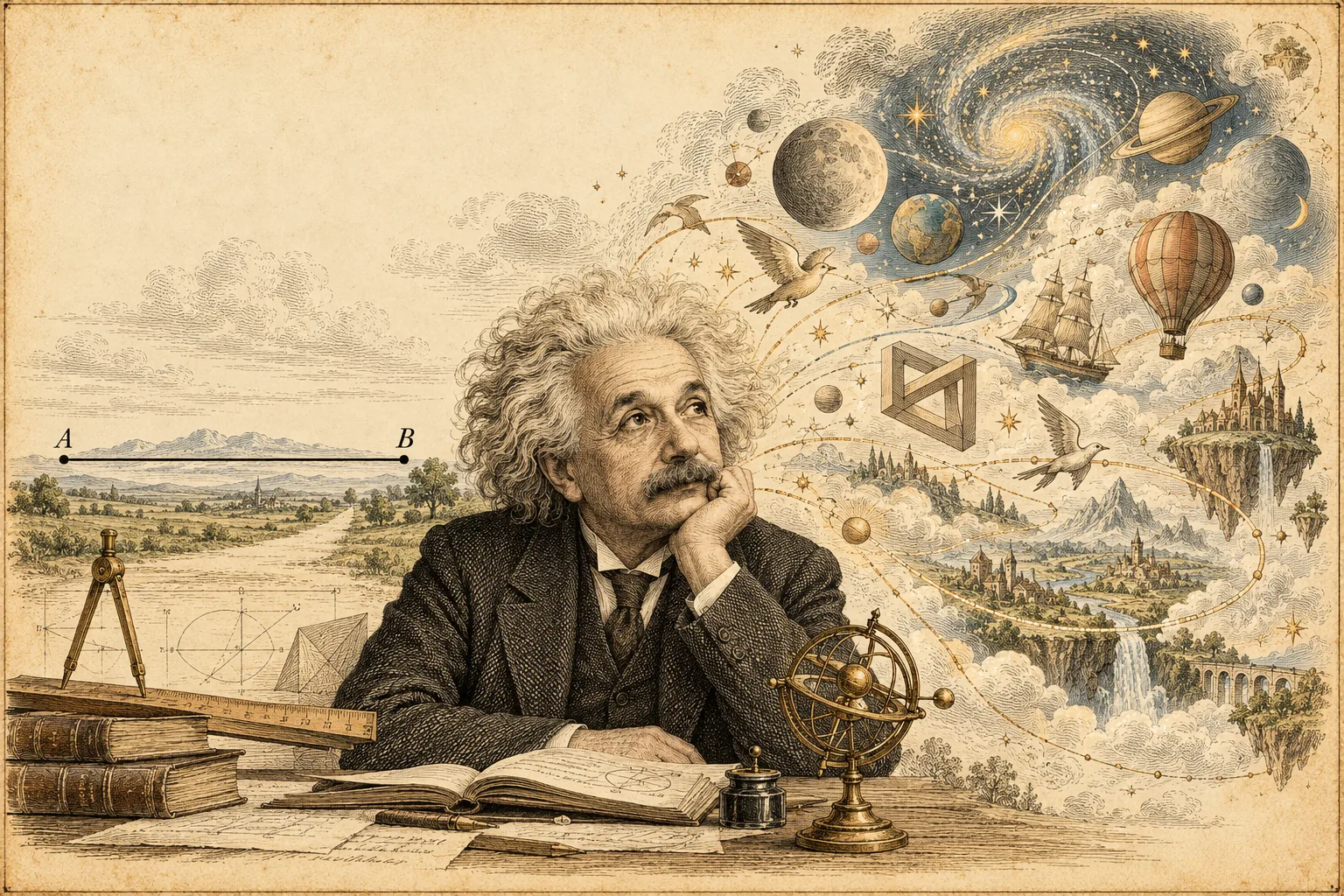
I said something else at that fireside chat that I'll repeat without the cheek: we still need to build the stuff, with humans. I stand by it, with one edit. The humans doing the building are the ones holding the drawings. Knowledge gets you from A to B. Imagination gets you everywhere else, and for the first time in history the rest of the trip is on sale.
The measurement problem
So here's my advice for the next time someone tells you tradies are safe. Don't argue. Show them the bell curve from 2024, then the one from September. Then show them Anthropic's two rings, 81 and 0.3, and ask which one the price curve is moving toward. Then show them the half-marathon, and Figure's four boring hours of housework. Then ask them which shift they'd like the robot to take first. And then ask the better question, the one that decides who wins the next three years: what would you build if the brain cost a sip and the body cost a ute?
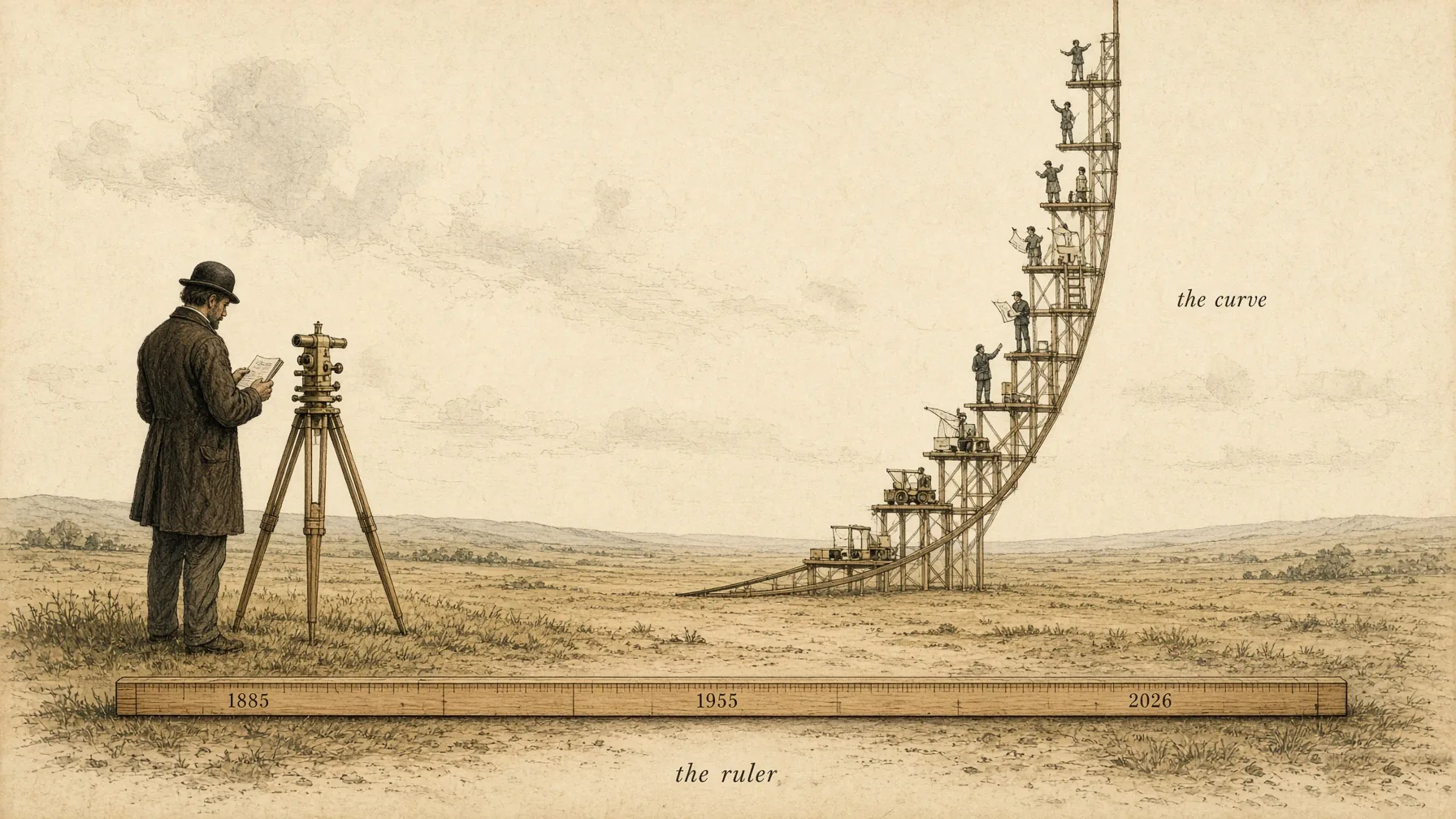
Doc Brown's leap backward looked alien because the missing machines were obvious. Ours looks ordinary because the new machines arrive wearing familiar shapes: a biped with hands, a van that drives itself, a factory that still has a gate and a badge reader. The alien thing was never the silhouette. It's the rate.
Seventy years one way lands you among horses. Seventy years the other way, give or take a year, lands you in a September where a robot walked off its own production line, another ran faster than any human, and a third cleaned thirty strangers' houses. Equal spans. Unequal worlds.
The question was never whether progress feels fast. It's whether you're still measuring it with a ruler built for a slower century. The ruler belongs to the survival game. The curve belongs to the Architects.
🖖
Artificial Ignition is written from the Sunshine Coast, Queensland, Australia.
#ArtificialIgnition #AI #ExponentialShift #AICompass #FutureOfWork