I've been staring at a chart for the past two weeks. It plots 27 countries on two axes: how much they're actually using AI, and how much they believe it's worth using.
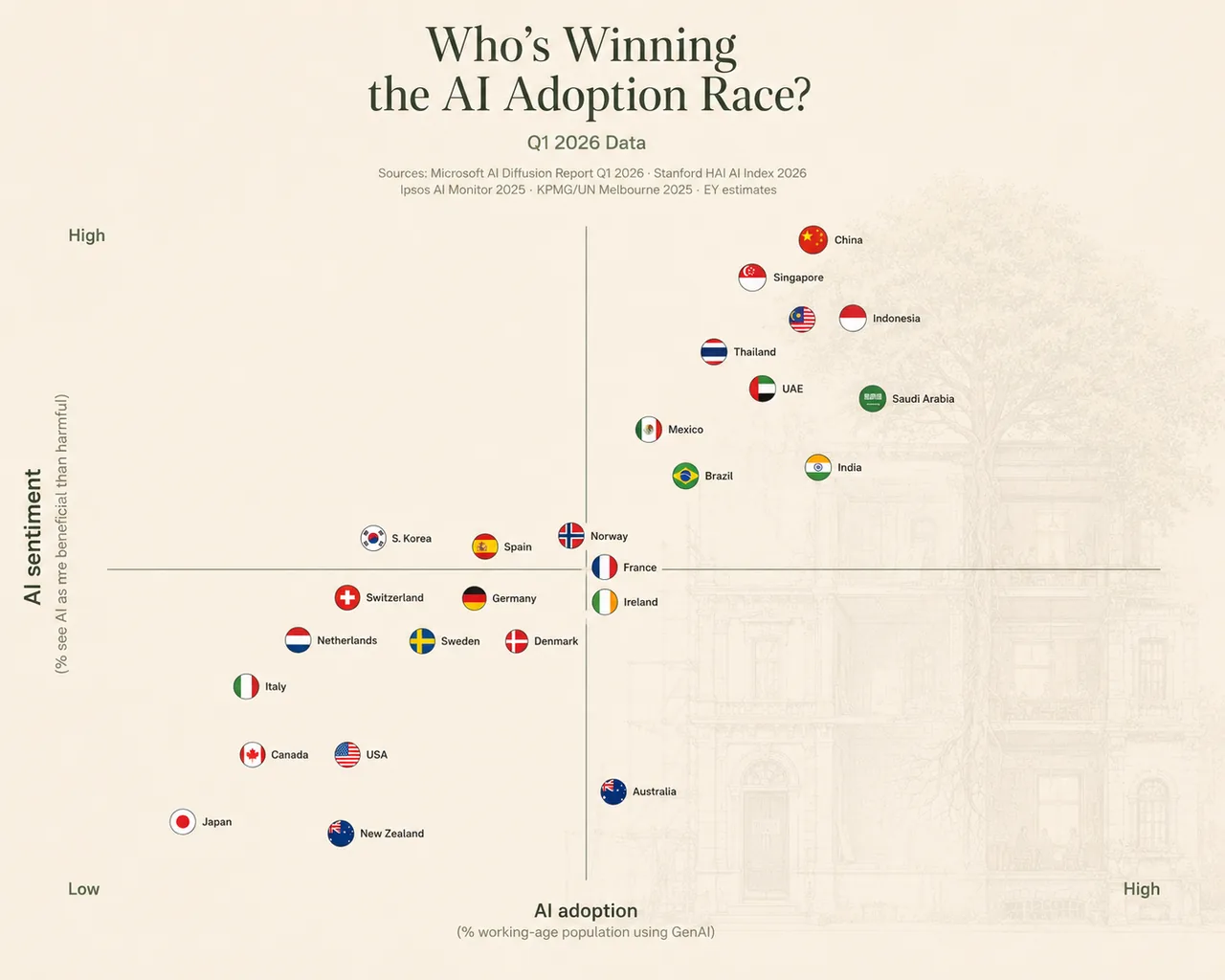
Australia sits at 48% adoption and 44% sentiment. That puts us 6th globally on usage, which sounds impressive until you look at the other axis. Out of every country surveyed, Australians are the least likely to believe the benefits of AI outweigh the risks. Almost dead last. Not among the sceptics - one of the most sceptical.
We're the country that uses the thing but doesn't believe in the thing.
That's not caution. That's cognitive dissonance on a national scale.
The numbers behind the feeling
If the chart were the only data point, you could argue it's a sentiment blip. It's not.
Deloitte's 2026 State of AI in the Enterprise report surveyed over 3,000 senior leaders globally. Only 12% of Australian respondents said generative AI is transforming their business or industry. The global figure is 25%. We're not lagging by a few percentage points. We're running at half the rate.
Only 35% of Australian businesses prioritise AI-driven productivity, against a global average of 42%. Investment intention sits almost 20 points below the global benchmark. And 76% of Australian SMEs have no formal AI strategy at all, despite 83% of them believing AI will significantly impact their business within a year.
Read that again. Eight in ten believe it matters. Fewer than one in four have a plan for it.
I've seen this pattern in person. In networking rooms, boardrooms, and discovery calls across Queensland this year. The gap between "I know I should" and "I've actually started" isn't closing. It's widening (with one exception - big enterprises).

The advice that keeps it wide
There's a script circulating in Australian business right now. You'll hear it in boardrooms, on discovery calls, at networking events, and in internal strategy meetings. It goes like this:
"We can't optimise anything until the foundation is solid."
"We need to sort our data first."
"I'd say we're about twelve months away from being ready for that conversation."
I've heard versions of these three sentences from project managers, IT leads, and operations directors across half a dozen industries this year. Different organisations, different contexts, same vocabulary. It's not a coincidence. It's a framework, picked up from consultants, conferences, LinkedIn posts, and vendor pitch decks, that gives people the language to make waiting sound strategic. It makes me allergic to those sentences.
And some of the people distributing that framework benefit directly from the wait. I'll probably lose friends for saying this, but it needs to be said. A segment of the consulting industry, particularly the LinkedIn-visible layer, has built a business model around perpetual readiness. Phase one, assess. Phase two, plan. Phase three, govern. Phase four, re-assess because things have changed since phase one. Somewhere around phase seven, maybe you build something. Maybe.
It's consultancy as a subscription service. And the client pays until they either run out of patience or run out of budget.
The problem isn't that foundations don't matter. They do. Data matters. Governance matters. But there's a difference between building a foundation and excavating one forever. One leads to a house. The other just leads to a deeper hole and another invoice.
Meanwhile, somewhere inside the same organisation, a senior leader who's been quietly rethinking their position on AI is ready to move. But they can't, because the loudest voice in the room just quoted a readiness framework that puts implementation beyond the next two budget cycles.
I've seen that standoff more times than I can count this year. The person who's done the thinking wants to build. The person who's absorbed the script wants to wait. And the script wins, because caution always sounds more responsible than action.
The KPMG / University of Melbourne Trust in AI survey backs this up structurally. 64% of Australian organisations have provided zero AI training to their staff. 93% can't measure AI ROI. We're not waiting because we have a plan. We're waiting because we don't, and "readiness" sounds better than "we haven't started."

Bricklayers and architects
Here's the distinction that matters, and it's one the market isn't making clearly enough.
The "wait until you're ready" approach is mostly being propagated by the bricklayers of the AI consulting industry. They know materials. They know processes. They can lay a solid row. But they're working without a blueprint for the building itself. They'll tell you which brick to use and where to put the mortar, but they can't tell you what the finished structure should look like, why it should face that direction, or how the landscape around it is shifting while you're still mixing cement.
What Australian businesses actually need right now are architects. People who can stand back far enough to see the full scope of what's changing, not just the next task on the checklist, but the broader forces reshaping how businesses operate, compete, and survive. Architects don't start with "let's audit your data." They start with "what does your business need to look like in 18 months, and what's the fastest path between here and there that doesn't break anything critical on the way?"
That's a fundamentally different conversation. It's scoping, strategy, and clarification, not an endless loop of assessment and reassessment. It's pointing a business owner in a direction with a clear rationale, not spinning them in circles until the next quarterly review.
The bricklayer says: "You're not ready." The architect says: "Here's what ready enough looks like, and here's how we get there while building."

The market is flooded with bricklayers right now. LinkedIn is full of them. They post frameworks, readiness checklists, maturity models, and twelve-step programs for AI adoption. Most of it is well-intentioned. Some of it is useful at a tactical level. But without the architectural vision sitting above it, all of that activity just produces a very well-organised delay.
Business owners deserve better than that. They deserve someone who can look at their operation, understand where AI creates real value, and design a path that gets them there in weeks or months, not fiscal years. Someone who treats their budget like it's finite and their time like it's running out. Because it is.
The data question
Now, before anyone reads this as "ignore your data and just ship things," let me be direct about something. Data security matters. Data privacy matters. Access controls, governance frameworks, proper configuration of AI models, guidelines about which data silos get exposed to which systems - all of that is critically important. I'm not dismissing it. I'd be irresponsible if I did.
If an AI model is configured without proper boundaries, without clear access rules, without understanding what data is sensitive and what isn't, the consequences are real. Client data in the wrong output. Financial records surfaced where they shouldn't be. Compliance exposure that could cost the business more than the efficiency it gained. I've seen poorly configured AI implementations create exactly these problems, and the cleanup is ugly.
So yes, the people raising data governance as a concern are right to raise it.
Where they go wrong is the conclusion they draw from that concern. "Our data isn't ready" doesn't have to mean "stop everything for twelve months." It can, and should, mean "let's understand what data we have, what's sensitive, what needs boundaries, and what we can start working with right now."
The tools available today can help you do that triage in days, not quarters. AI itself is one of the best instruments for scanning your own data landscape, flagging gaps, identifying what's sensitive, and mapping where your risks actually sit. Using it to understand your data is not the same as giving it unrestricted access to everything you own. These are different conversations, and conflating them is one of the most common mistakes I see in the field.
The responsible approach isn't to wait until every data point is perfectly catalogued and every policy is written. It's to start with clear boundaries on what the AI can access, build within those boundaries, learn what works, and expand the scope as your confidence and governance mature. Contain, build, iterate, expand. Not wait, wait, wait, panic.
Data is crucial. Context around that data is crucial. But using the importance of data as a reason to do nothing is like refusing to drive because you haven't memorised every road in the country. You don't need the whole map. You need to know where you're going and what lanes to stay in.
What starting actually looks like
Let me be specific, because the counter-narrative isn't theory.
A nonprofit with scattered spreadsheets and no central data system was told they weren't "ready" for AI. They used it anyway, to scan existing documents and surface patterns. Result: $400K in grant funding opportunities they'd been too busy to manually research.
A trades business with zero written SOPs, all knowledge in the owner's head, used a notetaker and AI transcription across three afternoons. First SOP library built in days, not months.
A financial planning practice with inconsistent CRM data was told they needed to clean up first. They used AI to scan existing records and flag gaps instead. Compliance risk areas surfaced immediately, and the cleanup was prioritised with AI assistance.
None of these organisations was ready. All of them started anyway. And in every case, AI wasn't the reward for having clean data. It was the tool that helped them see the mess clearly enough to fix it.
The speed at which you can sort and structure data using modern tools has changed fundamentally. The idea that you need 12 months to get your data house in order before you touch AI is 2022 thinking running in a 2026 world.
Use the advanced tools. Sort your data in two weeks, not two quarters. Make the first builds. Iterate. Balance the workload on your people so they're not burning out trying to compete manually against teams that already have AI in the stack.

The divergence is already here
AI Lab Australia's 2026 analysis found that growing SMBs are 1.8 times more likely to invest in AI than declining ones. Not twice as likely to talk about it. Twice as likely to actually spend on it. That's a self-reinforcing cycle. The productive get more productive. The hesitant fall further behind. And the gap compounds.
Indeed's hiring data tells the same story from a different angle. Two-thirds of all AI-related job postings in Australia come from just 1% of employers. The investment isn't spreading. It's concentrating.
This isn't a future risk. It's a present condition. And every month that a business spends in "readiness mode" without shipping anything is a month where the gap between them and the businesses that are already building gets harder to close.
Signal, noise, and the battlefield
There's a reason this moment feels harder to navigate than previous technology shifts. It's not just the speed of change. It's the volume of noise surrounding it.
We are living through what might be the most difficult signal-to-noise ratio in the history of human decision-making. Every platform, every feed, every inbox is saturated with AI opinions, AI predictions, AI vendor claims, AI doomsday scenarios, and AI get-rich-quick promises. Sorting genuine insight from recycled hype has become a skill in itself, and most business owners don't have four hours a day to develop it. They're running operations, managing people, and trying to keep the lights on while the ground shifts beneath them.
This is one of the great challenges of our time, and it doesn't get acknowledged enough. The information is out there. The tools are available. The capability exists. But the ability to filter, prioritise, and act on the right signals while ignoring the noise - that's where most businesses are stuck. Not because they're stupid. Because the noise is genuinely overwhelming, and the people producing it have more incentive to generate volume than clarity.
Here's where the battlefield analogy earns its place.
Strategy without action is dangerous and worth nothing. You can have the most brilliant plan on the whiteboard, the most thorough readiness assessment, the most beautifully documented governance framework, and if none of it turns into something operational, it's just expensive decoration. It looks responsible. It feels productive. It achieves nothing.
Action without strategy is lethal and damaging. Jumping into AI with no clarity on what problem you're solving, no boundaries on data access, no understanding of what success looks like, that's how you burn budget, burn trust, and burn out your team. I've seen that too, and it's not pretty.
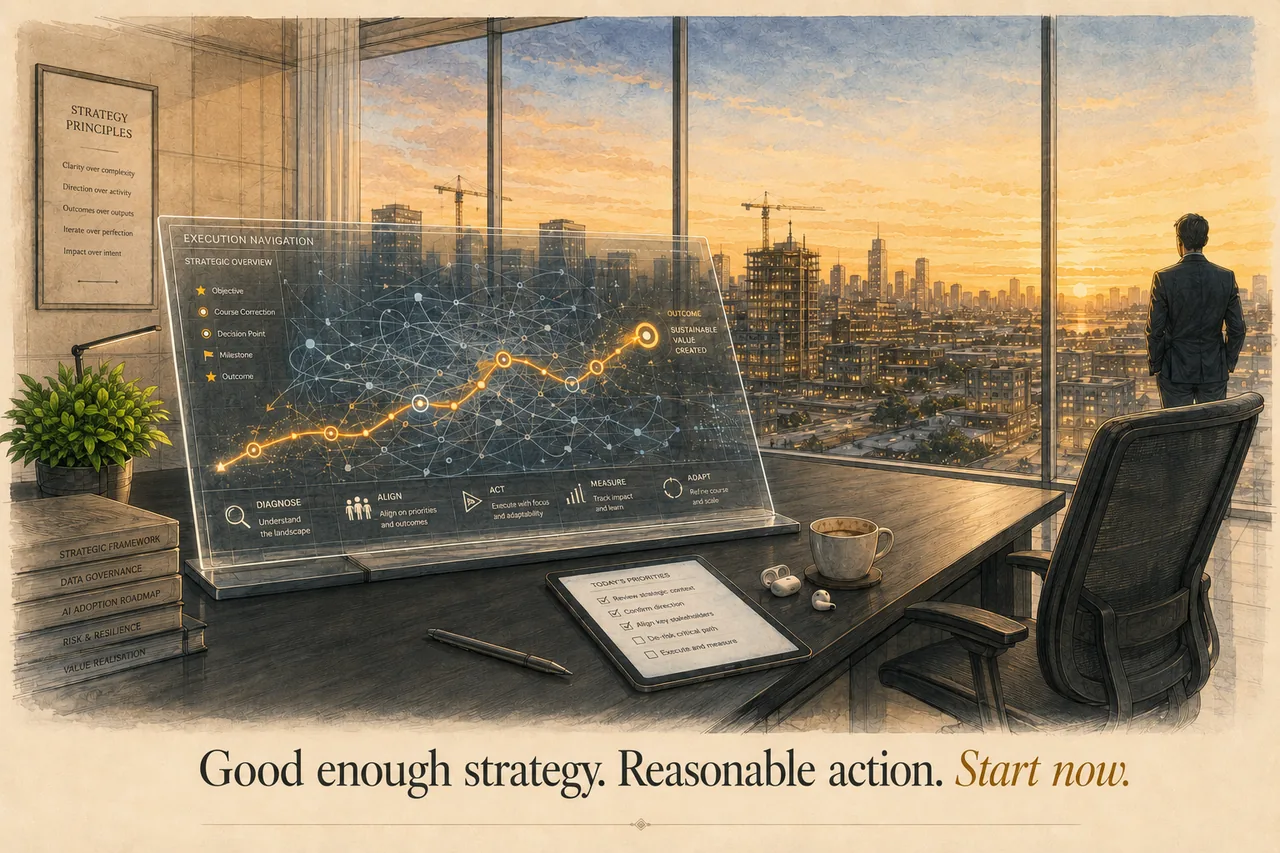
But here's the part that separates this from a classroom exercise. Both of those are constrained by time. Because while you're perfecting your strategy or recovering from your reckless action, the other side - your competitors, your peers, the market itself - is moving with good enough strategy and reasonable action. And that combination, imperfect as it is, beats perfect plans and frozen ambition every single time.
The organisations winning at AI right now aren't the ones with the best strategy documents. They're the ones who found the balance between thinking and doing, between governance and speed, between caution and momentum. They're playing the game, adjusting as they go, and getting better every iteration, while the perfectionists are still on draft three of their readiness report.
You don't need a perfect map. You need a compass, a direction, and the willingness to start walking.
The clock
I'm not writing this to scare anyone. I'm writing it because I've been in the rooms.
I've watched organisations with messy data find six-figure opportunities in their first week of AI adoption. And I've watched others spend six months being consulted into standing still.
The readiness trap isn't about bad people. It's about an outdated playbook being applied to a technology that doesn't follow the old rules. AI doesn't wait for you to be ready. It rewards whoever starts.
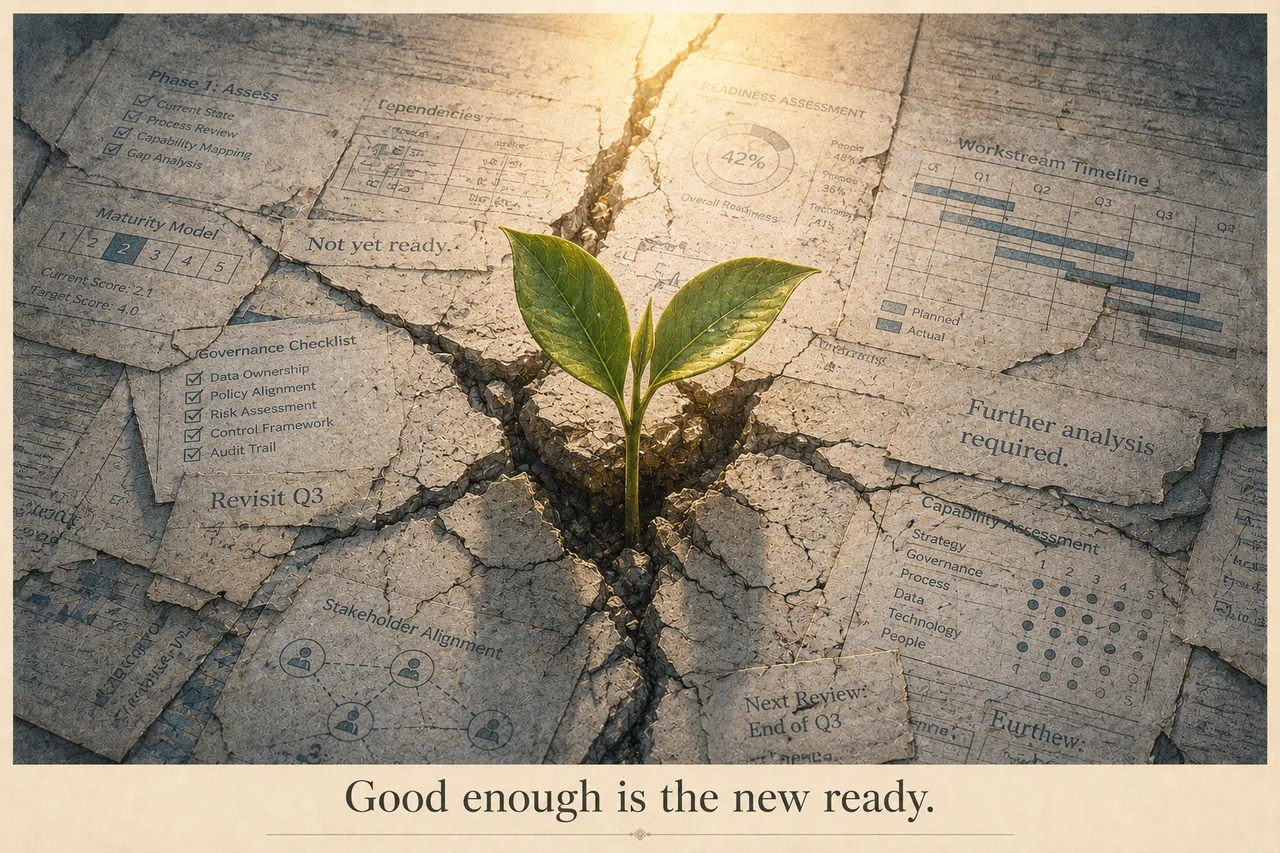
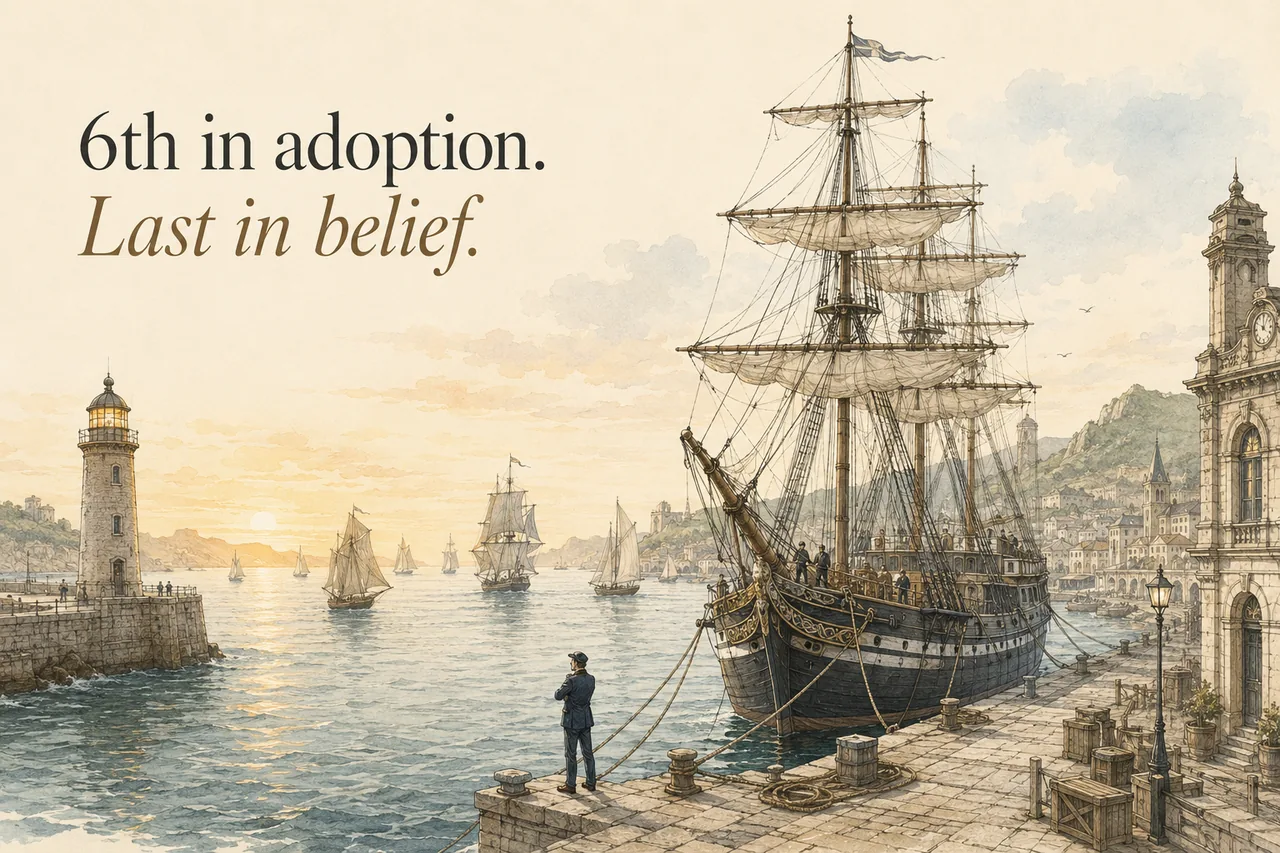
Australia is 6th in the world at using AI. One of the last in the world at believing in it. That gap is where the opportunity lives, and where the risk compounds.
Good enough is the new ready. Start there. 🖖
Artificial Ignition is written from the Sunshine Coast, Queensland, Australia.
Sources: EY AI Sentiment Study 2026, Microsoft AI Diffusion Report Q1 2026, Stanford HAI AI Index 2026, Ipsos AI Monitor 2025, KPMG / University of Melbourne Trust in AI 2025, Deloitte State of AI in the Enterprise 2026, Cisco / Governance Institute of Australia 2025, Indeed Hiring Lab AU 2026, AI Lab Australia 2026, Decidr AI Readiness Index 2025, Tech Council of Australia / Datacom 2026.
#ArtificialIgnition #AICompass #AustralianBusiness #AIAdoption #AIStrategy #ReadinessTrap #SunshineCoast