This morning, the government told us not to panic. This afternoon, it set up a new office to run the thing we're not meant to panic about.
The report came first. On 8 July, the Department of Employment and Workplace Relations published its first proper attempt to measure whether AI is eating Australian jobs. The verdict was calm. No sign of a bloodbath, unemployment sitting at 4.4%, graduate outcomes holding, the labour market strong by the numbers we usually trust. The one wobble was quiet: the roles most exposed to AI, the clerical and admin work, grew slower than the rest. A drift, not a collapse. The headline most people took away was the reassuring one. Relax.
Then, today, in Sydney, the Prime Minister announced an Office of AI inside his own department and called it a world first. He framed the whole thing around jobs. Secure jobs. AI as an instrument to make them, not a threat that takes them. He said Australia should be more than a data warehouse for products built somewhere else, and that we can still set the terms if we move now.
Put those two things next to each other and something doesn't add up. If the jobs data were really the whole story, you wouldn't build a new office in the Prime Minister's own department to manage it. You don't legislate national standards for a rounding error. So here's the question the week is actually asking, underneath all the reassurance: is work really the only thing we should be worried about?
I don't think it is. I think we're all staring at the employment line on the graph while the ground underneath the graph quietly shifts. The thing being repriced isn't jobs. It's value itself.
The machine we've all been running
For about two hundred years the deal has been simple enough to explain to a ten-year-old. You do work. Work makes things people want, or moves things people need, or solves problems people have. That work creates value. Money is how we keep score. It's the receipt, the storage tank, the thing you carry from the work you did on Tuesday to the meal you buy on Friday. Money isn't the value. It's the carrier. A promise that value happened somewhere and you're owed a slice of it.
That machine has swallowed every tool we've ever thrown at it. Steam didn't break it. Electricity didn't break it. The internet didn't break it, it just made the receipts move faster and further. Every time, the same pattern: new tool, more output per human, the money adjusts, the machine keeps running.
Here's my claim, and it's the spine of everything below. Money isn't going anywhere. What changes with AI is not the receipt. It's what the receipt is quietly counting. For two centuries money has been a claim on human effort. We're moving into a period where money becomes a claim on three things that don't sit together neatly, and only one of them is human effort at all.
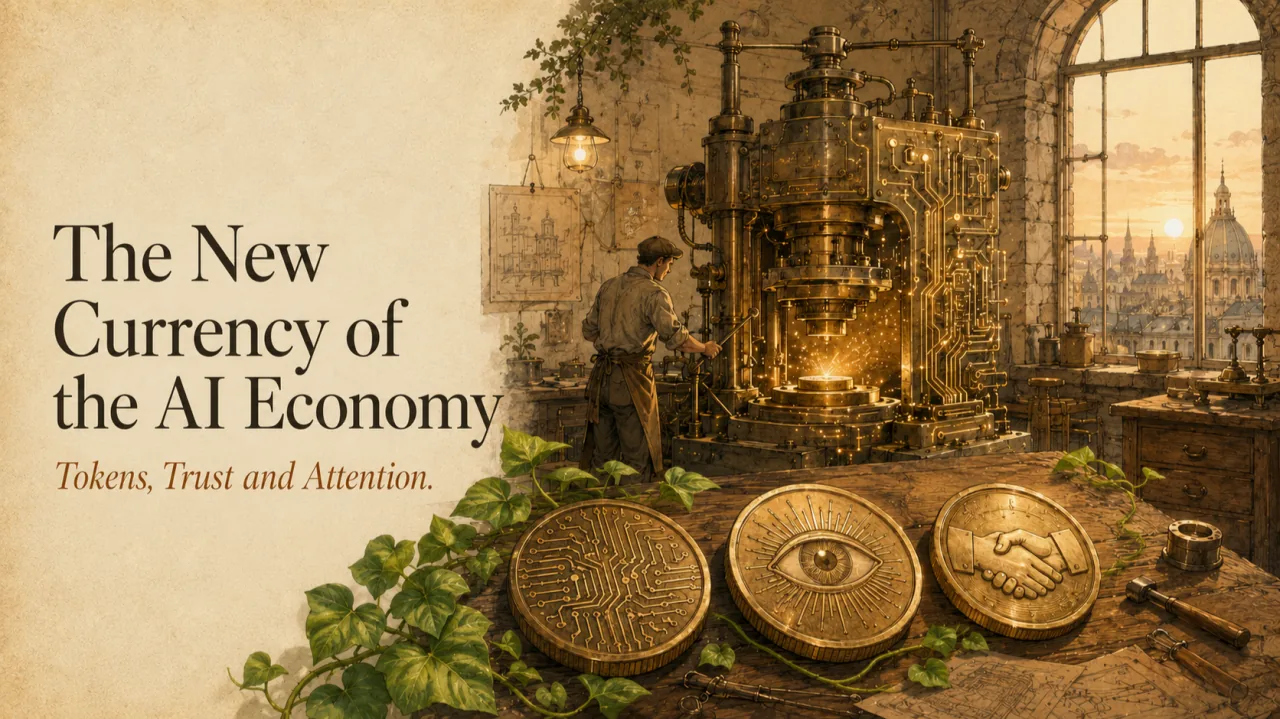
I've been carrying these three around for a while, testing them against client work and against the news, waiting to see if they fall apart. They keep holding. Tokens, attention, and trust. Not a slogan for a keynote slide. A working model for where value actually pools once intelligence gets cheap.
Let me take them one at a time.
... but before that, a quick detour, because I built you something
A few months back, I put together a map of the Australian job market. Every occupation, sorted by how exposed it was to AI, the desks the technology could reach and the ones it couldn't. Plenty of people shared it, argued with it, and forwarded it to their teams. But it was a prediction. A picture of risk, not of damage.
This month the government checked the homework.
The Department of Employment and Workplace Relations went and measured whether any of that exposure has actually cost anyone a job yet. The short answer is no, not broadly. The labour market's healthy, young people are holding up, even software developers grew. But there's a faint signal underneath. The jobs most exposed to AI are still growing, just slower than everything else, and that gap has been quietly widening for about a year.
The reason I trust this report is that it argues with itself. The warning sign only shows up clearly with one way of measuring, and fades with others. The people who wrote it call it a reason to keep watching, not proof of anything. That kind of honesty is rare in this space, so I wanted to hand it to you straight.
I read most of the eighty-four pages, so you don't have to (but feel free to - link to the source attached at the bottom of the article), and turned it into something you can click through in about two minutes. Three views: the good news, the catch, and how sure we really are.
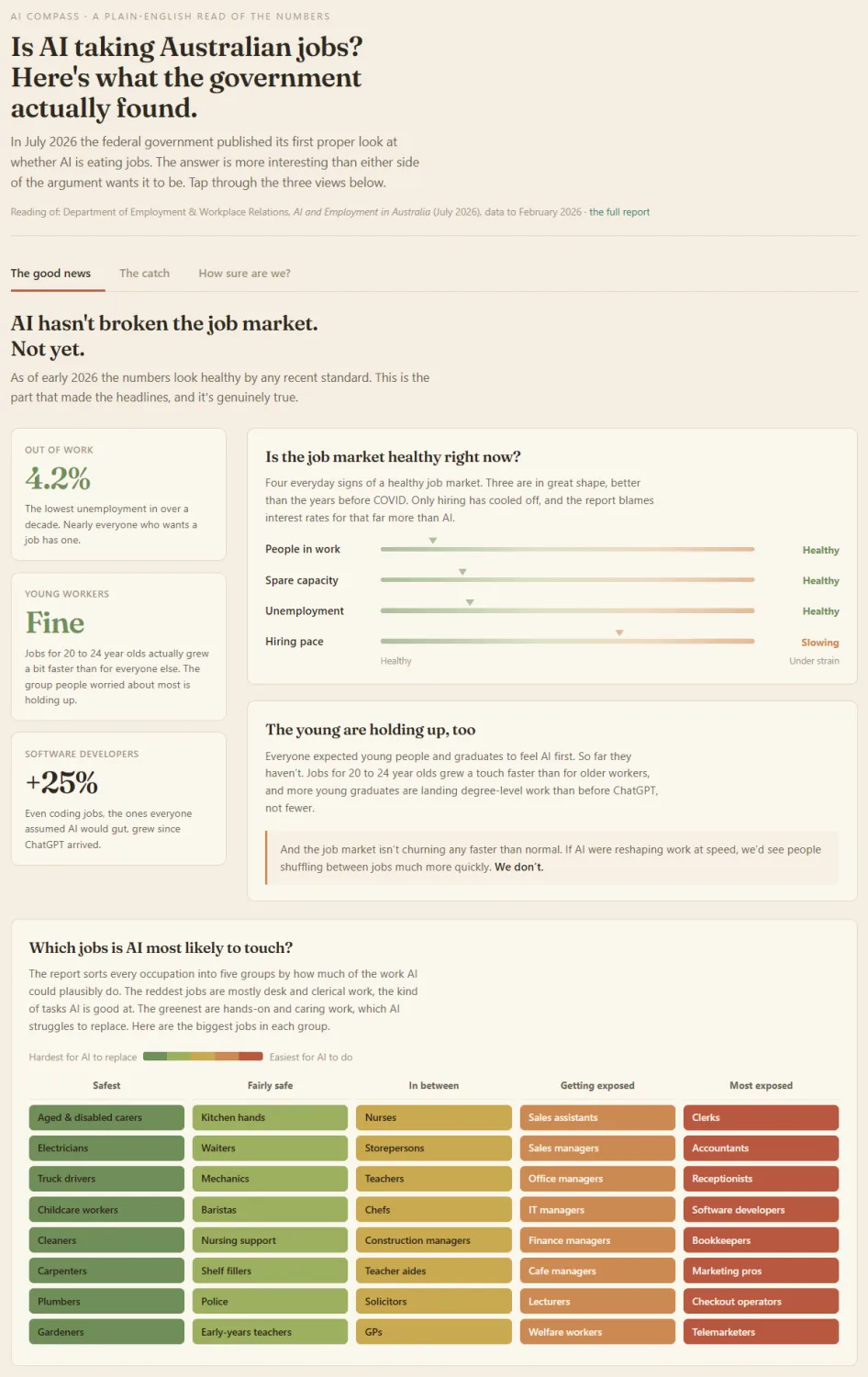
Now look at what the report is quietly measuring. The jobs softening first are the ones made of tasks AI can do cheaply. The token work. The jobs holding up are the ones built on judgment, care, and dealing with other humans. Trust and attention. Canberra has spent eighty-four pages proving the thesis of this newsletter without meaning to.
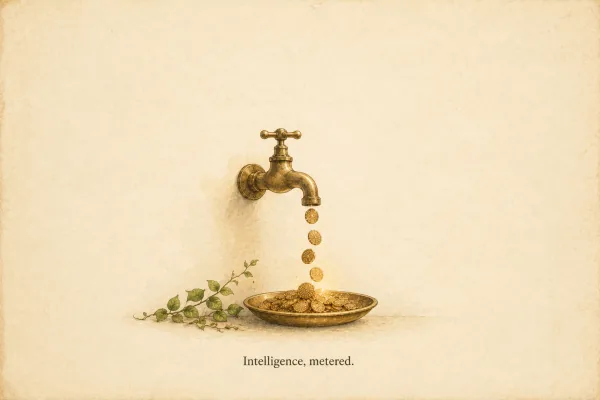
Tokens: intelligence, metered
Start with the strange one, because it's the newest.
A reader named Curt asked me a question a few issues back that I still haven't fully finished answering. Roughly: if you rolled the clock back to the birth of the internet, would all this ignition talk have applied then too? The honest answer is that the internet was the setup, not the payoff. Everything we built for thirty years, digitising libraries, conversations, invoices, photos, arguments, receipts, was the training ground being laid down before anyone knew what it was for. No internet, no digitisation of nearly everything humans know, no AI. We spent three decades pouring the concrete. The building only went up recently.
And now that intelligence has a meter on it. That's what a token is. Strip away the jargon and a token is the unit your AI charges you by, a fragment of a word, a slice of thought, the smallest billable piece of machine cognition. When you ask a model to draft a contract, read a scan, or plan a route, it burns tokens the way an old factory burned coal. Intelligence used to be a fixed cost you hired by the head and paid by the year. Now it's a variable cost you buy by the sip.
Mo Gawdat put it well on Diary of a CEO recently. He talked about borrowing IQ, renting a hundred extra points of intelligence any time you need them. That's the token economy in three words. You no longer have to be smart about everything. You have to be smart about what to borrow, when, and whether to believe what comes back.
Two things follow, and they matter. First, if intelligence is something you can meter and buy, then intelligence gets cheap, and cheap things stop being where the money is. Nobody builds a fortune selling tap water. Second, and this is the uncomfortable one, tokens are the part of this whole story that is purely machine. There's no human warmth in a token. It's compute, electricity, and maths. Which is exactly why it can be priced, throttled, exported, and switched off by a government you didn't vote for. We watched that happen earlier this year. If your entire advantage is the intelligence you rent, you've built your house on someone else's land.
So tokens are real, tokens are the new fuel, and tokens are also the least defensible thing you can own. Hold that thought.
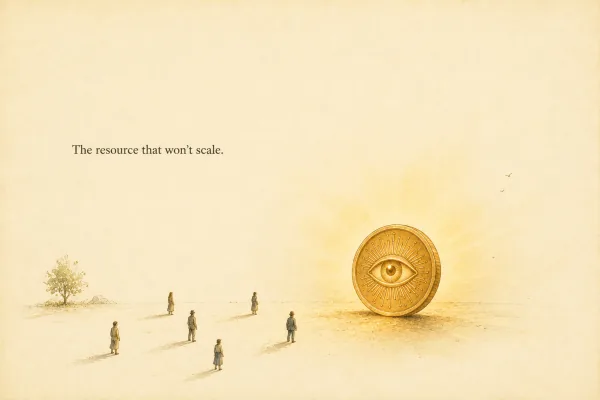
Attention: the resource that won't scale
Here's the pivot. If intelligence is getting cheap, what's getting expensive?
Attention. Yours, mine, your customer's, your team's. It's the one input in this entire economy that flatly refuses to scale. You can spin up a thousand AI agents before lunch. You cannot manufacture a single additional hour of a human being's genuine, undivided attention. There are eight billion of us and the same twenty-four hours there have always been, and now every one of those hours is being fought over by systems built specifically to win the fight.
That's the quiet inversion. For most of history, the scarce thing was the answer and the cheap thing was the asking. Knowledge sat locked inside expensive heads and expensive books. Now the answer is nearly free, sold to you by the sip in a chat window, and the scarce thing is a person willing to stop and take it in. When answers cost nothing, attention becomes the bottleneck for everything. Every product, every pitch, every piece of work is really competing for the same thing: a slice of a finite, shrinking, ferociously contested human focus.
And AI makes this worse, not better, which is the joke almost nobody's laughing at yet. The same technology that made intelligence cheap is being pointed straight back at your attention to strip-mine it more efficiently. We built machines that generate infinite content and aimed them at a species with finite hours. Something has to give, and it won't be the hours.
So the second place value pools is obvious once you see it. Not in making more stuff. Anyone can make more stuff now, the marginal cost of a competent thousand words rounds to zero. Value pools with whoever has earned the right to be paid attention to in a room where everyone is shouting through the same amplifier.
Which brings us to the third one. Because attention isn't handed out at random. It's handed to the things we already trust.

Trust: the one you can't buy
Trust is the strange survivor in all of this. It's the one thing on the list that has stubbornly refused to get cheaper, faster, or automatable across the whole of human history, and it isn't about to start now.
You can buy tokens. You can buy attention, briefly, badly, and at a rising price, ask anyone running paid ads this year. You cannot buy trust. You can only earn it, slowly, in public, one kept promise at a time, and you can lose the lot in an afternoon. That asymmetry is the whole point. Trust takes years to build and minutes to burn, which makes it the most expensive thing to acquire and the most valuable thing to hold in an economy where everything else is being counterfeited by a machine.
Two receipts from the real world, because I don't want this floating off into theory.
The first is Ford. This year the company quietly rehired something like three hundred veteran engineers, many of them people it had already let go, after finding its AI systems couldn't hold the quality line on their own. One of its executives said the honest thing out loud: they'd mistakenly assumed that introducing AI and ingesting the design requirements would produce a high-quality product. It didn't. So the humans came back, not to do the work the machine now does, but to sit above it and sign off on it. Ford didn't discover that AI failed. It discovered that borrowed intelligence still needs a human to put their name against it. They'd automated the judgment before they'd captured it, and the judgment walked out the door with the people. Trust is what they had to rehire.
The second is closer to home, and it landed today. When the Prime Minister drew his line in the sand this afternoon, the line he refused to move wasn't about compute, or data centres, or investment dollars. It was about ownership. He ruled out weakening copyright and said, plainly, that Australian writers, musicians, artists and journalists keep control of their work. Set the politics aside for a second and just notice what the government instinctively reached to protect when the pressure came on. Not the tokens. The trust of the people who make the things worth trusting. I'll be straight, I don't trust this government, and trust is earned, not granted. But watch what even a government I don't trust reaches to protect when it gets serious. Trust. It's the asset you defend first.
Gawdat made the sharpest version of this point. His test for which AI company to believe isn't their benchmark scores, it's what they're willing to sacrifice. One firm walked away from half a billion dollars of surveillance work on principle. That's not a marketing line. That's a receipt. In a market where everyone claims to be responsible, the only signal that survives contact with reality is what you gave up to stay honest.
And here's why trust matters more than even all that suggests. Trust is the shock absorber. When things are going well, it looks like a soft, sentimental extra, the sort of thing that gets cut first when the finance team gets nervous. Then a crisis hits, a bad quarter, a public failure, a model that hallucinates something expensive into existence, and you find out very fast whether you had any. The businesses that survive a stumble are the ones whose customers give them the benefit of the doubt for a week while they fix it. That benefit of the doubt has a name. It's trust, and you either spent years building it before you needed it, or you didn't, and no pile of tokens buys it back in the moment you do.
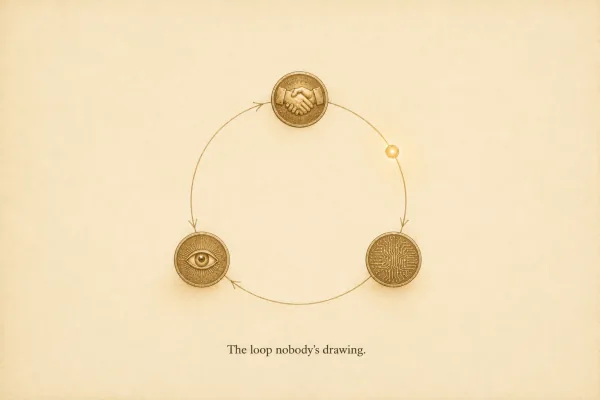
The loop nobody's drawing
Now put the three together, because on their own they're just nouns. Together they're an engine.
Trust earns attention. People stop for the ones they believe. Attention creates demand, because attention is the raw material you convert into a decision, a purchase, a yes. Demand pulls in intelligence to meet it, and that intelligence runs on tokens, the metered machine cognition doing the work at scale. Then the output of all that, the thing the machine made and the human shipped, does one of two things. It keeps the promise, and trust compounds. Or it breaks the promise, and trust drains.
That's the loop. Trust to attention to intelligence to tokens, and then back to trust, either topped up or bled out depending on whether the thing you made was any good.
Read it one way and it's a flywheel: trusted people command attention, attention justifies borrowing serious intelligence, that intelligence produces work good enough to deepen the trust, and round it goes, faster each turn. Read what happens when you cheat it and it's a drain: buy attention you didn't earn, point cheap intelligence at it, ship something hollow, and you spend trust you can't replace chasing tokens you can. Plenty of businesses are about to run that second loop at industrial speed and then wonder why the numbers looked great for two quarters and fell off a cliff in the third.
The tokens are where all the noise is right now, the funding rounds, the model launches, the export controls, the office the Prime Minister just built. But tokens are the commodity in this picture. They're the fuel. Fuel is necessary, and fuel is never where the margin lives. The margin lives at the two human ends of the loop, in who you've earned the trust of and what you can make people pay attention to. That's the part no model ships, no government exports, and no competitor can copy off your website.
Human first isn't a slogan, it's the arithmetic
I've been saying "human first" for a while now, and I'll admit it can sound like the sort of warm nothing you'd print on a mug. So let me say what I actually mean, now that the model's on the table.
Human first isn't a values statement. It's a reading of where the value sits. Machines now own the middle of the loop. They generate the intelligence, they burn the tokens, they do the cognition, and they'll keep getting better and cheaper at it whether we approve or not. What they don't own, and I'd argue can't own, are the two ends. The trust that opens the door. The attention that walks through it. Those get built the way they've always been built, by one human being deciding another human being is worth believing, and worth listening to.
So the technology amplifies. It always has. But amplification needs a signal, and the signal is still human. Point the loudest amplifier ever built at a broken promise and all you've done is broadcast the break further. The machine makes you faster at whatever you already are. If you've earned trust, it compounds it. If you haven't, it exposes you at scale.
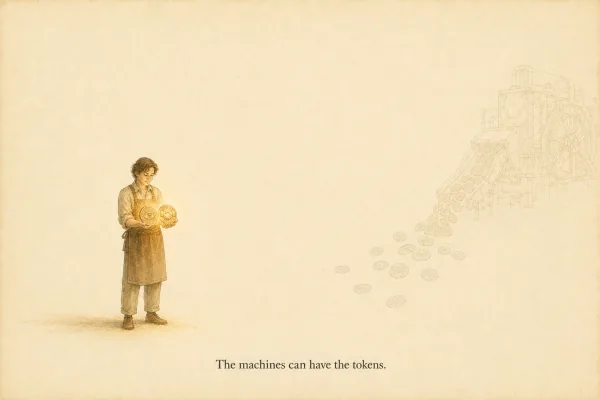
That's the whole thesis, and it's oddly steadying for a piece that opened with a government standing up an office to manage the future. The two most valuable things in the AI economy turn out to be the two oldest things we've got. Being worth believing. Being worth listening to. The machines can have the tokens. Those were always going to get cheap.
The rest is still ours, if we bother to earn it. 🖖
Artificial Ignition is written from the Sunshine Coast, Queensland, Australia.
Source: Department of Employment and Workplace Relations, AI and Employment in Australia (July 2026). Explore the interactive summary at aicompass.com.au/tools.
#ArtificialIgnition #AI #FutureOfWork #TrustEconomy #AICompass