Black Friday is here!
Visionary Friday | November 28, 2025
While the world chases discounts on televisions and toasters, a different kind of sale is happening. The price of accessing genius-level intelligence just dropped to $20 a month.
This morning, while half the planet was hunting bargains, I was scrolling LinkedIn and stumbled across Prof. Marek Kowalkiewicz ‘s piece about Move 37. If you don’t know the story: in 2016, an AI called AlphaGo made a move in the ancient game of Go that three thousand years of human masters had collectively decided was impossible. The AI won. But the fascinating aftermath is what stopped me cold. Researchers later found that, over the previous 66 years, the quality of professional Go play had flatlined. The best players weren’t getting better. After Move 37? Human players rapidly became better than at any point in the previous seven decades, not by imitating the machine. By unlearning the assumptions that the machine had exposed.
As I commented to Marek: “We’re witnessing first contact in real-time. What a privilege, and a little scary, to have front-row seats.“
That insight, combined with what’s been landing on my screen all month, made me realise we need to talk about what’s actually on sale this Black Friday.
Look at what happened in the AI intelligence markets over the past few weeks.
- November 12-13, OpenAI releases GPT-5.1, warmer, faster, smarter, with adaptive reasoning that knows when to think deeply and when to respond instantly.
- November 17, xAI drops Grok 4.1, topping the LMArena leaderboard with 1483 Elo in thinking mode and a 2-million-token context window.
- November 18, Google launches Gemini 3 Pro with a breakthrough 1501 Elo score, the first model ever to cross the 1500-point threshold.
This thing can maintain coherent reasoning chains for 10-15 logical steps where previous models would lose their train of thought at step 5 or 6. And Claude Opus 4.5, which I’m using right now to help craft this piece, continues demonstrating capabilities that genuinely surprise me.

Where is AI IQ?
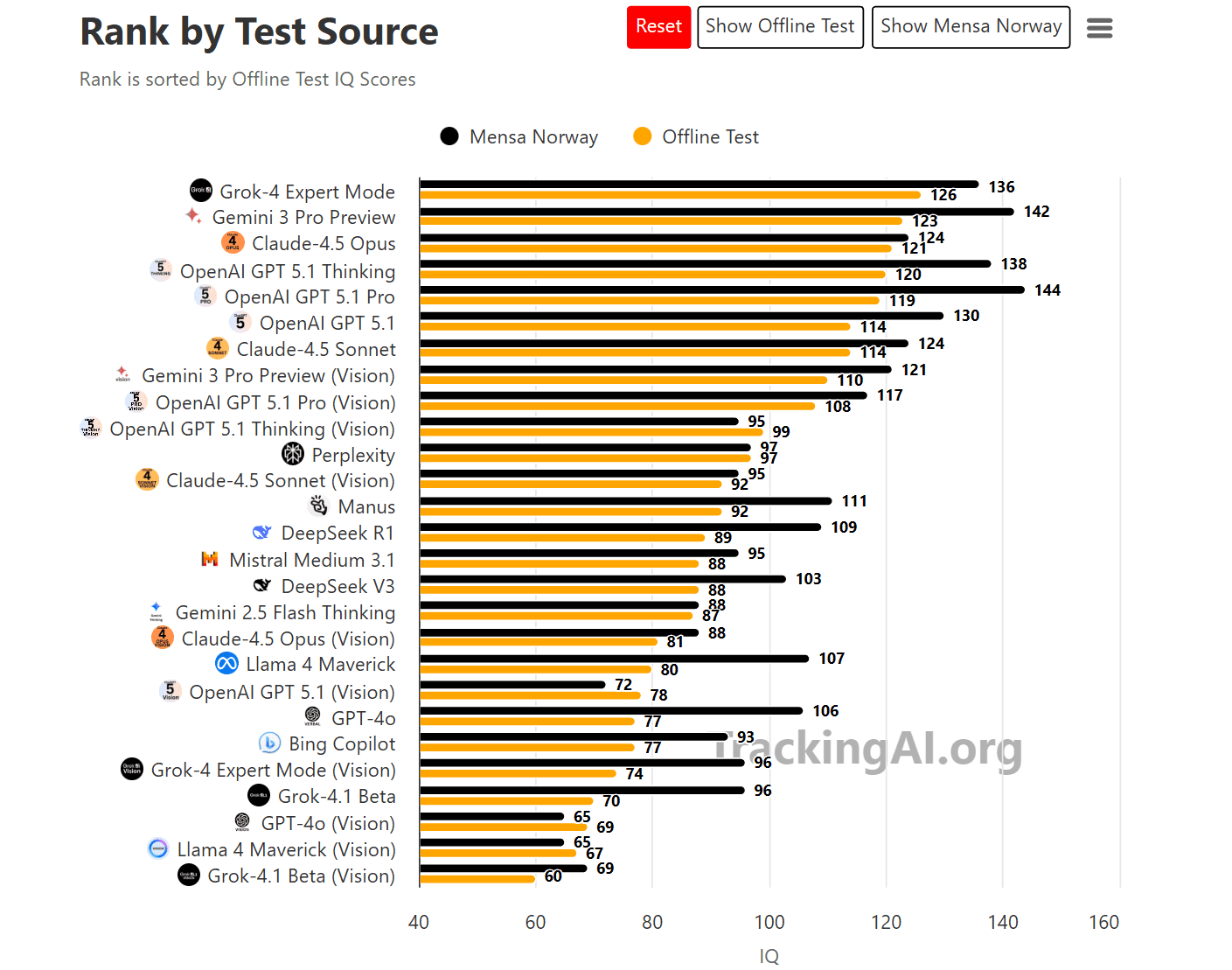
Now here’s the data that should make you pause. TrackingAI.org, run by Maxim Lott of the Maximum Truth project, has been testing these models on Mensa-calibre IQ tests. The results as of November 27, 2025: GPT-5.1 Pro scores 144 IQ. Gemini 3 Pro Preview hits 142. GPT-5.1 Thinking reaches 138. Grok-4 Expert Mode lands at 136. Claude-4.5 Opus comes in at 124. To put this in context, Mensa membership requires 130 or above. We now have multiple AI models scoring well into Mensa territory, with the top performers approaching the genius threshold of 145+. Six months ago, the frontier models were clustering around 100-110.
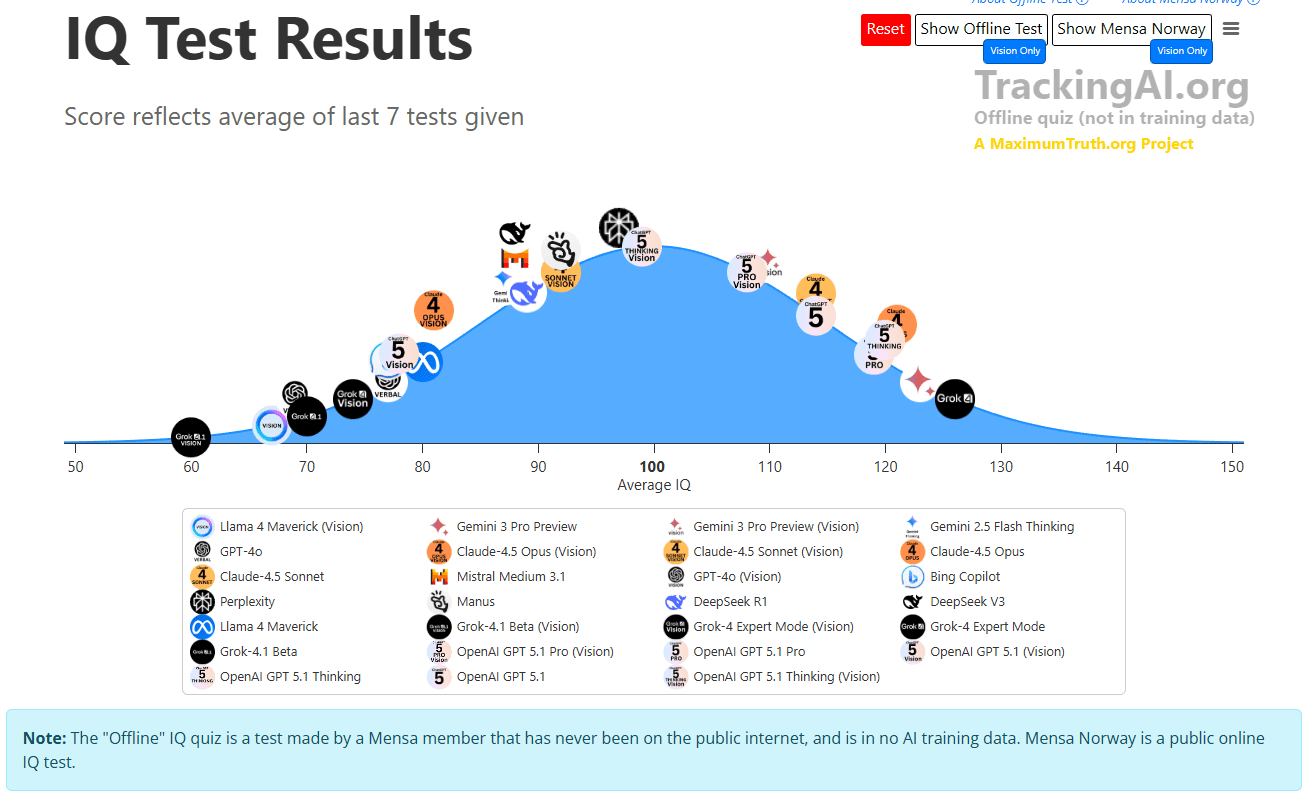
The slope of improvement isn’t linear. It’s not even exponential. It’s approaching vertical
And here’s the irony that’s been gnawing at me all day. Millions of humans are queuing, physically and digitally, to save $200 on a television. Meanwhile, access to intelligence that would have been worth billions a decade ago, that governments would have classified as strategic assets, is available for less than a cup of coffee per day. A ChatGPT Plus subscription runs $20 a month. Claude Pro, same. SuperGrok, $30. Google AI Ultra, around the same. For the price of a mediocre lunch, you can converse with systems that score higher on IQ tests than 99.7% of the human population. The real sale isn’t at your local electronics retailer. It’s in the intelligence markets. And most people are walking right past it.
A few months ago, I spotted reports claiming that AI is making humans dumber. The concern is real, but it misses the point entirely. If you use AI as a crutch, to do your thinking for you, to replace your cognitive work rather than augment it, yes, you will atrophy. Just as using a calculator for every simple sum eventually erodes your mental arithmetic. But the Go masters didn’t get dumber after Move 37. They got dramatically smarter. The difference? They didn’t just copy the machine’s moves. They interrogated their own assumptions. They asked why they believed certain things were impossible. What invisible rules they were following. What they’d inherited from their teachers that they’d never questioned.
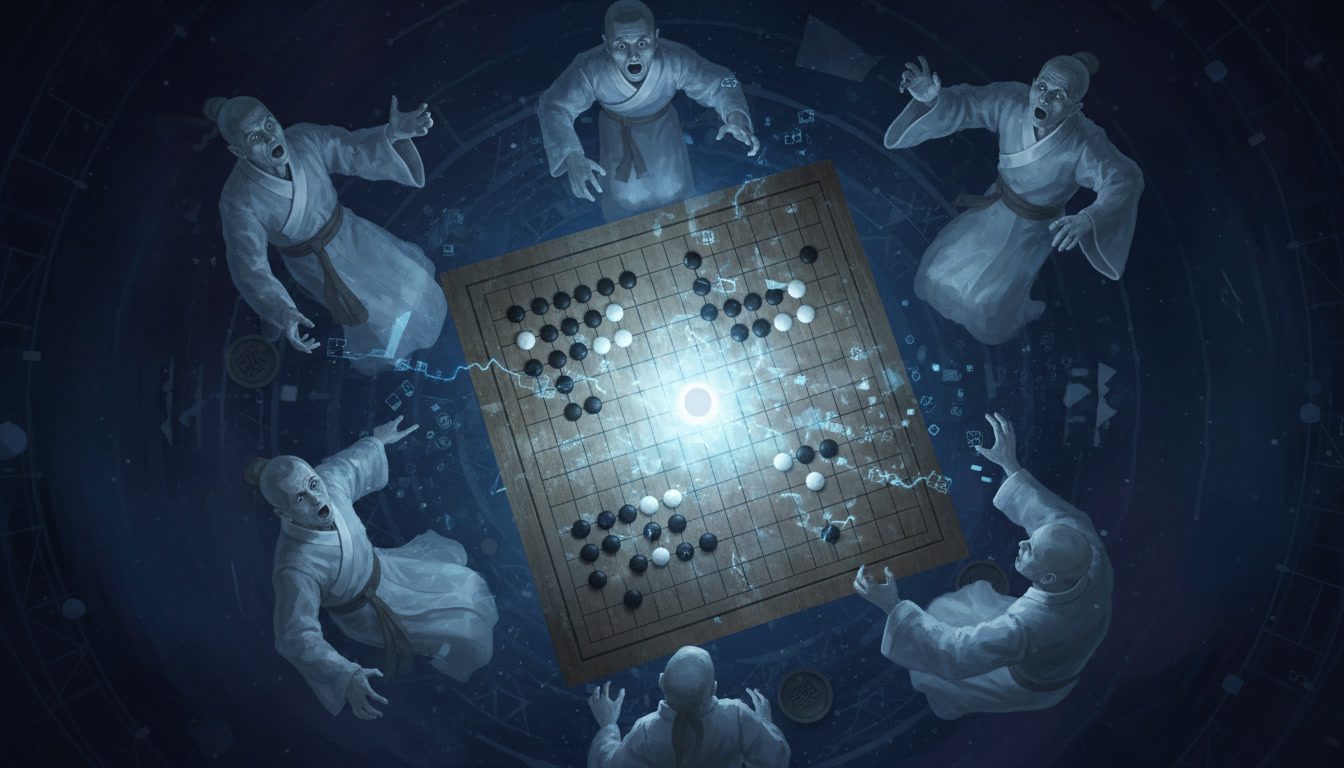
ALIEN Intelligence (AI)
AI thinks differently from us. It can act as a multiplier for your activities, but it can also bring entirely new values to the equation. Values you never knew existed because you were too busy optimising within boundaries you’d inherited. That’s not a bug. That’s the feature.
Prof. Marek coined a term I’ve fully adopted: “alien intelligence” rather than “artificial intelligence.” It’s a crucial reframe. “Artificial” suggests something fake, something inferior, something manufactured. What we’re dealing with isn’t artificial. It’s genuinely alien. These systems evolved under completely different selection pressures than human cognition. They have no inherited assumptions from teachers. No cultural biases about what works and what doesn’t. No collective agreements about what’s possible and impossible.
They just find what works. And in doing so, they offer us a mirror. Not a mirror that shows us what we look like, but a mirror that shows us what we assume. What we take for granted. What we’ve never questioned.

But this amplification of human intelligence only happens if we choose it. The Go players could have quit. They could have declared the game ruined. They could have retreated into nostalgia and dismissed the machine’s moves as aberrations. Some probably did. But those who chose differently, who approached the alien with curiosity rather than defensiveness, who asked “what can I learn here?” instead of “how do I compete with this?”, those are the ones who made the breakthrough. The same choice stands before every professional, every business, every industry right now. You can use these 140+ IQ systems as glorified search engines, as faster typewriters, as tools that do your work so you don’t have to think. Or you can use them as sparring partners, as mirrors, as alien intelligences that expose your invisible assumptions and force you to question what you thought you knew. One path leads to cognitive atrophy. The other leads to a leap forward that makes the last 66 years look like standing still.

Here on the Silicon Coast, and yes, I will keep calling the Sunshine Coast that until it sticks, we’re in a peculiar position. We’re not San Francisco. We’re not London. We’re a regional Australian community that happens to have world-class digital infrastructure, direct submarine cable connections to Asia, and a growing ecosystem of businesses who understand that something fundamental has shifted. The companies that will thrive aren’t the ones that use AI to do things faster. They’re the ones that use AI to discover what they didn’t know they were missing. The question isn’t “Can AI do this task?” The question is “What is AI doing that we’d never try, and why not?”